

One moment you are fine, and the next, a sharp jolt runs from your hip down the back of your leg, sometimes all the way to your foot. If this sounds familiar, especially once the monsoon sets in, you are far from alone. Sciatica, that unmistakable shooting pain, tends to flare up noticeably during the rains, catching many people off guard year after year.
This pain is not random. It follows the path of the sciatic nerve, the longest and widest nerve in the body, running from the lower back through the hip and down each leg. When something presses on or irritates this nerve, the result is the sharp, radiating pain many people describe as electric or burning.
In this guide, we explain what sciatica is, why it tends to worsen during the rainy season, what Ayurveda says about it, and how doctor guided Ayurvedic care can offer complementary support alongside your regular treatment.
What Is Sciatica? Understanding the Pain That Travels From Hip to Leg
Sciatica is not a disease in itself. It is a set of symptoms caused by irritation or compression of the sciatic nerve, most often from a herniated disc, spinal stenosis, or a tight piriformis muscle pressing on the nerve path. The result is pain that starts in the lower back or buttock and radiates down one leg, sometimes reaching the foot.
Interestingly, Ayurveda described this exact pattern of pain long before modern anatomy mapped the sciatic nerve. It is known as Gridhrasi, a term drawn from the Sanskrit word for vulture, because the stiff, limping gait of someone in the middle of a flare resembles the vulture’s characteristic walk.
Common Symptoms of Sciatica You Should Not Ignore
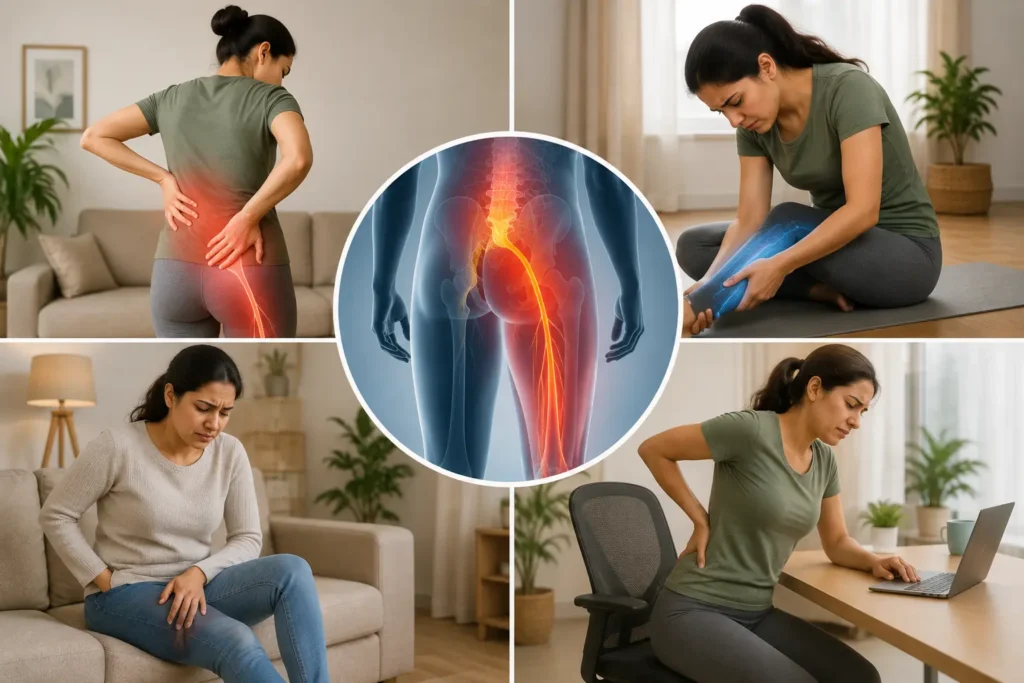
Sciatica symptoms can range from a mild ache to pain sharp enough to stop you in your tracks. Here is what to watch for.
1. Sharp or Burning Pain From Lower Back to Leg
The hallmark of sciatica is pain that travels along a clear path, from the lower back or buttock, down the back or side of the thigh, sometimes reaching below the knee. It is usually felt on one side at a time.
2. Tingling, Numbness or a Pins and Needles Feeling
Many people notice tingling or numbness alongside the pain, especially in the calf or foot, as the irritated nerve struggles to send signals normally.
3. Weakness in the Leg or Foot
In more pronounced cases, the affected leg may feel weak, or you may notice difficulty lifting the foot while walking. This is a sign the nerve compression needs prompt medical attention.
4. Pain That Worsens on Sitting, Coughing or Sudden Movement
Sitting for long periods, coughing, sneezing or bending suddenly can all intensify sciatic pain, since these movements increase pressure on the lower spine and the nerve roots.
Please note: Seek immediate medical attention if you experience loss of bladder or bowel control, numbness in the inner thighs or groin area, or weakness in both legs together. These can be signs of a rare but serious nerve emergency that needs urgent evaluation, not home care.
Not Sure What Is Behind Your Hip and Leg Pain?
At Ayurvishwa Healthcare, our doctors assess your Prakriti, posture, digestion and lifestyle through Nadi Pariksha before recommending a plan built around your specific pattern of pain.
Book your consultation today and take the first step toward moving comfortably again.
Why Sciatica Flares Up During the Rainy Season

If your sciatica seems to have a mind of its own every monsoon, Ayurveda has a fairly clear explanation for why.
According to Ayurveda, the rainy season, called Varsha Ritu, naturally aggravates Vata Dosha, the force responsible for all movement in the body, including nerve function. Cold, damp weather is believed to increase this aggravation further, adding stiffness and heightened sensitivity to already vulnerable nerves and joints.
Modern observations line up closely with this idea. A drop in atmospheric pressure during rain is thought to cause tissues around the joints and nerves to expand slightly, adding pressure where there is already irritation. Increased humidity affects circulation, and cooler temperatures tend to tighten muscles around the lower back and hip, both of which can intensify nerve related pain. A survey by the Indian Society of Rheumatology found that a large majority of people with joint pain cut back on their daily activity during the monsoon simply because of the discomfort, which in turn can make stiffness and pain worse over time.
Ayurveda adds one more layer to this picture, weakened Agni during the monsoon. When digestion slows down, the body struggles to eliminate toxins, referred to as Ama, and this buildup is believed to further burden Vata affected areas such as the lower back and sciatic nerve path.
The Ayurvedic View: Sciatica as Gridhrasi
In Ayurveda, sciatica falls under Vata Vyadhi, disorders caused by aggravated Vata Dosha. Apana Vayu, the branch of Vata that governs the lower abdomen, pelvis and legs, is considered the most disturbed in this condition.
Ayurveda describes two broad patterns. Vataja Gridhrasi presents with sharp, shooting, dry pain, stiffness and restlessness. Vata Kaphaja Gridhrasi, where Kapha joins the imbalance, tends to bring a duller, heavier ache, along with numbness, coldness and a feeling of lethargy in the affected leg. Identifying which pattern fits your case helps guide the right combination of diet, herbs and therapies.
Ayurvedic Herbs and Therapies for Sciatica Relief
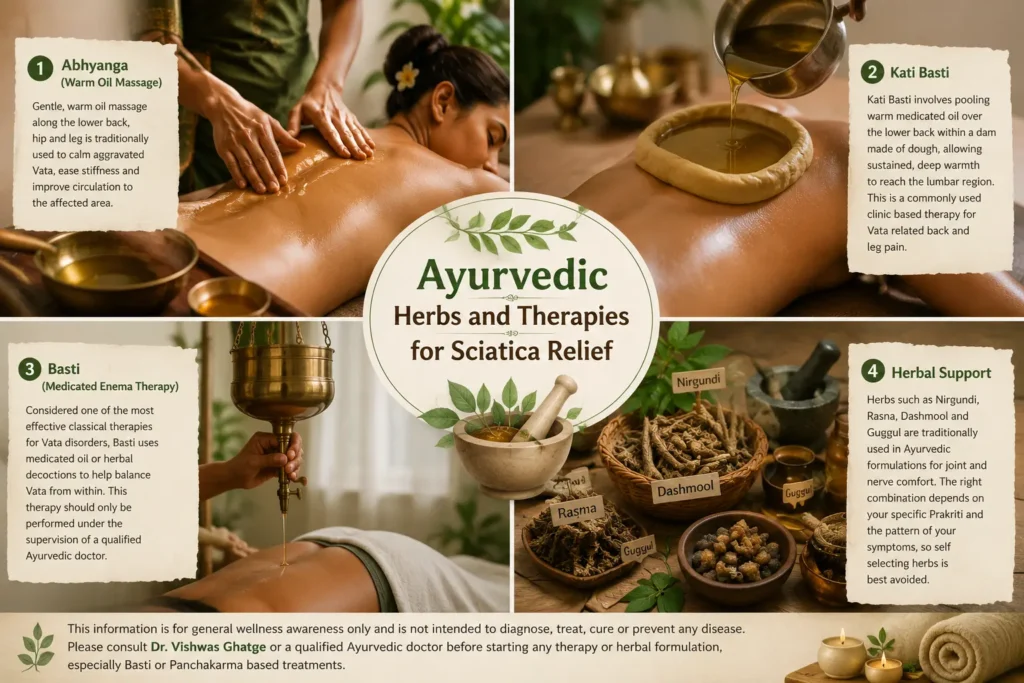
Under the guidance of a qualified Ayurvedic doctor, several classical therapies and herbs are traditionally used to support comfort and mobility in sciatica, alongside your regular treatment.
1. Abhyanga (Warm Oil Massage)
Gentle, warm oil massage along the lower back, hip and leg is traditionally used to calm aggravated Vata, ease stiffness and improve circulation to the affected area.
2. Kati Basti
Kati Basti involves pooling warm medicated oil over the lower back within a dam made of dough, allowing sustained, deep warmth to reach the lumbar region. This is a commonly used clinic based therapy for Vata related back and leg pain.
3. Basti (Medicated Enema Therapy)
Considered one of the most effective classical therapies for Vata disorders, Basti uses medicated oil or herbal decoctions to help balance Vata from within. This therapy should only be performed under the supervision of a qualified Ayurvedic doctor.
4. Herbal Support
Herbs such as Nirgundi, Rasna, Dashmool and Guggul are traditionally used in Ayurvedic formulations for joint and nerve comfort. The right combination depends on your specific Prakriti and the pattern of your symptoms, so self selecting herbs is best avoided.
This information is for general wellness awareness only and is not intended to diagnose, treat, cure or prevent any disease. Please consult Dr. Vishwas Ghatge or a qualified Ayurvedic doctor before starting any therapy or herbal formulation, especially Basti or Panchakarma based treatments.
Diet and Lifestyle Tips to Prevent Sciatica Flares This Monsoon
Foods That Help Pacify Vata
- Warm, freshly cooked meals rather than cold or leftover food
- Healthy fats such as ghee and sesame oil, which help counter Vata dryness
- Warming spices like ginger, garlic and black pepper to support digestion and circulation
- Soaked nuts and well cooked lentils for grounding nourishment
Lifestyle Habits That Support Your Back and Nerves
- Stay warm and dry, and change out of wet clothes as soon as possible
- Avoid sitting in one position for long stretches, take short movement breaks through the day
- Practice gentle stretching or doctor approved yoga rather than staying completely still
- Use a firm, supportive mattress and maintain good posture while sitting
Sciatica often overlaps with other musculoskeletal complaints. If your discomfort feels more centered in the lower back itself, our guide on Ayurvedic back pain treatment may be useful, and if multiple joints are affected, our Ayurvedic care for joint disorders page covers this in more depth.
Get a Vata Balancing Plan Based on Your Prakriti
Every case of sciatica has a different pattern. Through Prakriti Parikshan, our doctors identify your unique body constitution and build a diet, lifestyle and therapy plan suited to your specific case.
Fill in the form and our team will help you book a consultation at your nearest Ayurvishwa clinic.
Common Mistakes People Make When Managing Sciatica

1. Ignoring the Pain or Self Treating for Too Long
Many people try to push through sciatica pain or rely only on pain relief balms for weeks at a time. If pain persists beyond a couple of weeks or keeps returning, it is worth getting a proper diagnosis rather than repeatedly self treating.
2. Staying in Complete Bed Rest for Days
It is natural to want to rest completely when the pain is sharp, but prolonged bed rest can actually make sciatica stiffer and slower to improve. Gentle movement, once your doctor confirms it is safe, generally supports recovery better than staying still.
3. Skipping a Warm Up Before Exercise or Yoga
Jumping straight into exercise or yoga postures without warming up the lower back and hips can aggravate an already irritated nerve. A slow, gentle warm up matters even more during the monsoon, when muscles are naturally stiffer.
4. Ignoring Red Flag Symptoms
Numbness in the inner thighs, loss of bladder or bowel control, or weakness in both legs are not symptoms to wait out. These need urgent medical evaluation, not home remedies.
Sciatica pain does not have to keep coming back every monsoon. Book a Nadi Pariksha based consultation with Ayurvishwa Healthcare and get a plan built around your unique Prakriti and pattern of pain.
Book Your ConsultationFrequently Asked Questions
Sciatica happens when the sciatic nerve, the longest nerve in the body, is compressed or irritated. Common causes include a herniated or bulging disc, spinal stenosis, or a tight piriformis muscle pressing on the nerve. The result is pain that radiates from the lower back or hip down one leg.
Ayurveda explains this as an aggravation of Vata Dosha during the rainy season, which governs movement and nerve function. Cold, damp weather, a drop in atmospheric pressure and reduced physical activity during the monsoon can all add to nerve sensitivity and stiffness, making existing sciatica feel more pronounced.
Ayurveda refers to sciatica as Gridhrasi, a Vata Vyadhi or Vata related disorder. It is understood as an imbalance of Apana Vayu, the aspect of Vata governing the lower body, sometimes combined with Kapha in more chronic, heavier presentations.
Not always. A slipped or herniated disc is one common cause of sciatica, but sciatic nerve pain can also come from spinal stenosis, piriformis muscle tightness, or other causes of nerve compression. A proper diagnosis helps identify the exact cause in your case.
Kati Basti and other Vata pacifying therapies are traditionally used to support comfort and mobility in sciatica, as a complementary approach alongside your regular treatment. These therapies should be performed by a qualified Ayurvedic doctor after a proper assessment of your condition.
See a doctor if pain persists beyond a couple of weeks, keeps returning, or limits your daily activities. Seek immediate medical attention if you notice numbness in the inner thighs or groin, loss of bladder or bowel control, or weakness in both legs.
Complete bed rest for extended periods is generally not recommended, as it can make sciatica stiffer over time. Once a doctor confirms it is safe, gentle movement and doctor approved stretching usually support recovery better than staying still.
Cold drinks, iced foods, and excess fried or heavy foods are generally best minimised, since Ayurveda considers them aggravating to Vata. Warm, freshly cooked meals with digestive spices like ginger and black pepper are usually easier on the body.
Most cases of sciatica improve with conservative care such as physiotherapy, medication guided by your doctor, posture correction and complementary Ayurvedic support. Surgery is generally considered only when symptoms are severe, progressive or do not respond to other treatment.
This varies depending on the underlying cause and severity, but many people notice gradual improvement over a few weeks with consistent care. Your doctor can give you a more accurate timeline based on your specific diagnosis and response to treatment.
Moving Through the Monsoon Without the Shooting Pain
Sciatica can feel unpredictable, especially when it seems to flare up every time the rains arrive. But the pattern is not random. Aggravated Vata, cold damp weather and reduced movement all play a role, and understanding this connection is the first step toward managing it better.
Ayurveda’s approach of pacifying Vata through diet, warmth, gentle movement and doctor guided therapies can offer meaningful complementary support alongside your regular treatment. At Ayurvishwa Healthcare, our doctors use Nadi Pariksha and detailed Prakriti Parikshan to build a plan suited to your specific pattern of pain.
If your pain is centered more in the lower back, or if multiple joints are involved, explore our Ayurvedic back pain treatment and Ayurvedic care for joint disorders pages, or visit our Ayurvedic treatment for sciatica page for a complete look at our approach. Ready to take the next step? Book your appointment at any of our 15+ clinics across Maharashtra today.