IBS & Chronic Constipation
Treatment in Ayurveda

Agni correction — not another tablet you “learn to live with.”

IBS and chronic constipation are called Grahani in Ayurveda — a disorder of the very site where digestion completes. Bloating after every meal, alternating loose and hard stools, cramping, gas and the constant unease of a gut you can’t trust. At Ayurvishwa Healthcare, Dr. Vishwas Ghatge (BAMS · MD Ayurveda) uses Nadi Pariksha to identify your specific Agni-dosha pattern and provide ayurvedic treatment for IBS that restores predictable, comfortable digestion — not just another prescription to manage around.

Book a Consultation Find Clinic Near You
ayurvedic clinic in Virar​ best ayurvedic doctor in Virar ayurvedic doctor in Virar ayurvedic doctors in mumbai Virar​ ayurvedic clinic in Virar mumbai​

Dr. Vishwas Ghatge

BAMS · MD Ayurveda · Founder
  • Identifies the Agni-dosha pattern behind your IBS symptoms through Nadi Pariksha
  • Treats bloating, irregular bowel, cramping and the gut-brain loop driving them
  • Online & offline consultations · 14 clinics across Maharashtra
Book Online Consultation Visit Our Clinic

Summary: Root-cause ayurvedic treatment for IBS and chronic constipation (Grahani) with Dr. Vishwas Ghatge, across 14 Ayurvishwa Healthcare clinics and online. Nadi Pariksha identifies the Agni-dosha imbalance and Ama accumulation behind your bloating, irregular bowel and gut discomfort — for a personalised plan of digestive medicines, gut-brain support, diet and lifestyle correction. Book your Nadi Pariksha consultation today.

What is IBS & Chronic Constipation?

Irritable Bowel Syndrome (IBS) is a long-term disorder of the gut characterised by recurrent abdominal pain, bloating, gas and altered bowel habits — constipation, loose stools or both — without any visible structural damage to the intestines. Chronic constipation is persistent difficulty passing stool — straining, hard or incomplete evacuation, fewer than three bowel movements per week — lasting months or years. The two overlap heavily: many IBS patients oscillate between constipation and urgency, and most chronic constipation patients develop bloating, gas and abdominal discomfort.

IBS affects approximately 10–15% of the population, is twice as common in women, and typically peaks during working age — exactly when daily life demands the most from your body. Conventional medicine classifies it as “functional” — meaning all tests are normal, but the symptoms are real. Treatment usually stops at antispasmodics, laxatives, fibre supplements and probiotics — managing episodes rather than correcting why the gut became unreliable. Patients frequently report being told to “live with it” or “manage your stress.” Ayurveda does not accept that answer.

Ayurveda’s core insight: “Functional” does not mean “no cause.” The cause is Mandagni — weakened digestive fire at Grahani, the very site where digestion completes. When Grahani malfunctions, food is released half-digested: sometimes too fast (loose), sometimes too slow (constipation), always producing Ama (toxins) that ferment into gas, bloating and pain.
IBS treatment in Ayurveda corrects Grahani’s fire — which is why the gut becomes predictable again, not just medicated around.

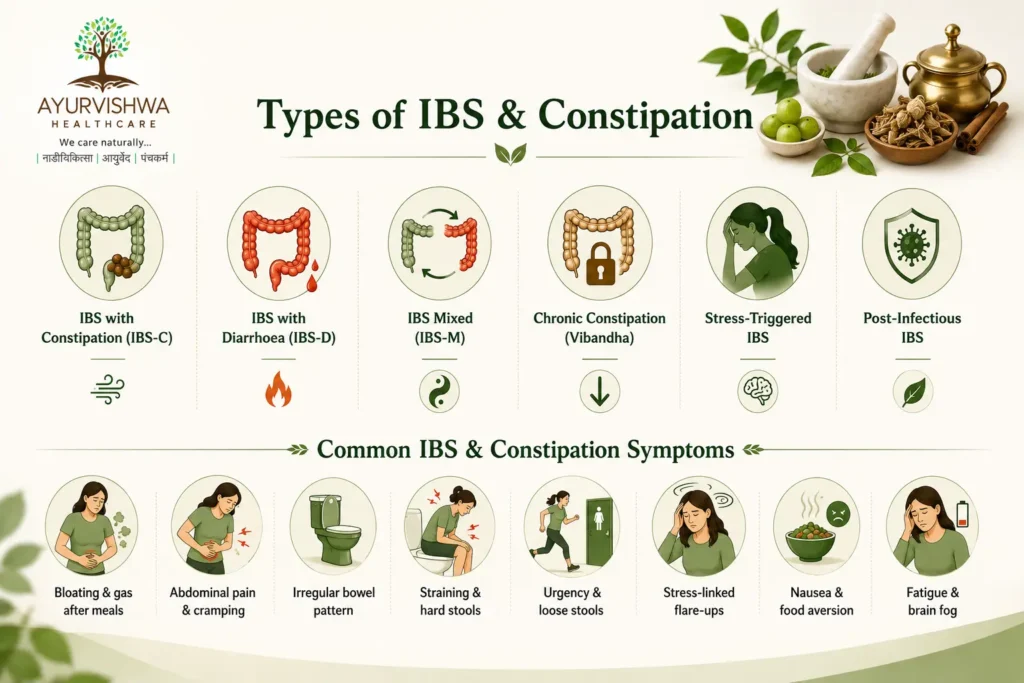
Types of IBS & Constipation

Each IBS subtype maps to a different dosha pattern — which is precisely why probiotics help one person and worsen another. Nadi Pariksha identifies your pattern before any medicine is prescribed.

Common IBS & Constipation Symptoms

IBS symptoms are real, disruptive and often dismissed. If this list reads like your daily life, it’s time to treat the pattern — not just manage around it. Read what Ayurveda says about bloating after every meal.

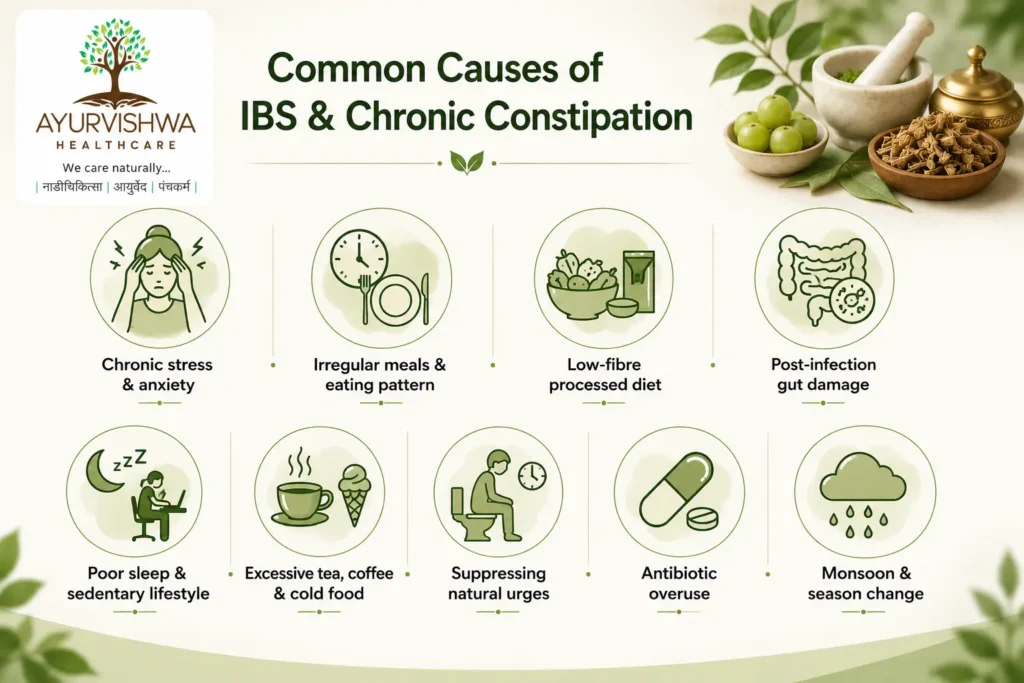
Common Causes of IBS & Chronic Constipation

In Ayurveda, these are Agni-weakening and dosha-disrupting factors — identifying your personal pattern is part of the treatment plan at Ayurvishwa Healthcare. See our guide on everyday habits that damage gut health.

IBS & Constipation in Ayurveda — Grahani

Grahani is one of Ayurveda’s most precisely described conditions. The term literally names the anatomical site — the Grahani organ, corresponding to the duodenum and upper small intestine, the seat of Agni where digestion completes and nutrients separate from waste. When Grahani malfunctions, food is released too early (loose stools) or held too long (constipation), always incompletely digested, always producing Ama.

The classical texts describe four types of Grahani by dosha — Vataja (gas, constipation, erratic), Pittaja (burning, frequent loose stools), Kaphaja (heavy, slimy, sluggish) and Sannipataja (mixed, unpredictable) — mapping almost exactly to the modern IBS-C, IBS-D, and IBS-M subtypes. Ayurveda also names the gut-mind connection explicitly: Mano dosha (mental disturbance) is a listed cause of Grahani, and treatment addresses both gut and mind — something modern IBS research is only now formalising as the gut-brain axis.

Why antispasmodics and laxatives alone are insufficient: An antispasmodic calms today’s cramp; a laxative softens today’s stool; a probiotic adds bacteria without asking why the ecosystem failed. None corrects the Mandagni that produces the Ama, the disturbed Vata that drives the irregularity, or the stress-gut loop that triggers the flare. Ayurvedic treatment for IBS addresses all three simultaneously — which is why the gut becomes predictable again instead of merely managed.

How Nadi Pariksha Diagnoses IBS & Constipation

No two gut patterns are identical — which is exactly why the same diet plan or probiotic works for one person and fails for another. Nadi Pariksha at Ayurvishwa Healthcare identifies your specific Grahani type, the strength of your Agni and the gut-brain contribution — making every prescription genuinely personalised. Read how pulse diagnosis works in Ayurveda.

Ayurvedic Treatment for IBS at Ayurvishwa Healthcare

Ayurvedic treatment for IBS at Ayurvishwa Healthcare follows a multi-stage protocol — clearing Ama, rebuilding Agni, regulating the bowel and calming the gut-brain loop. Every ayurvedic medicine for IBS is personalised to your Nadi Pariksha findings.

  • Agni deepana (digestive fire correction) — the classical foundation of Grahani treatment: rebuilding the weakened digestive fire so food is fully digested at the correct pace, ending the half-digested Ama cycle
  • Ama pachana (toxin clearance) — digesting and clearing the accumulated Ama from the gut channels so Agni can function without obstruction and bloating can resolve
  • Vata anulomana (bowel regulation) — gentle, non-habit-forming medicines that regulate Samana and Apana Vata, restoring predictable, complete, comfortable bowel movements without laxative dependence
  • Grahani-specific formulations — classical medicines targeting Grahani organ function directly — different for the diarrhoea-dominant, constipation-dominant and mixed patterns identified in your pulse
  • Mano chikitsa (gut-brain support) — when stress is a significant driver, mind-calming and adaptogenic formulations are added to break the anxiety-gut-anxiety loop that sustains IBS flare-ups

What to expect: Bloating and gas typically improve within 2–4 weeks. Bowel regularity stabilises over 4–8 weeks of consistent treatment. For long-standing IBS or severe constipation, the full Agni-rebuilding and gut-stabilisation phase runs 3–6 months. IBS is manageable and reversible in the vast majority of cases when Agni is properly corrected. Note: unexplained weight loss, blood in stool, persistent fever or symptoms beginning after age 45 warrant medical evaluation to rule out other conditions.

“‘Learn to live with it’ is not a treatment plan. Nadi Pariksha finds what your tests couldn’t.”

Book Consultation
ayurvedic clinic in kandivali​ ayurvedic clinic in kandivali west​

Dr. Vishwas Ghatge

Qualification BAMS · MD Ayurveda
Experience 15+ Years
Patients 1 Lakh+
Speciality Nadi Pariksha
Clinics 14 · Maharashtra
Related Conditions
Our Clinics

First appointment within 48 hours. Online & offline available.

IBS & constipation patients treated at Ayurvishwa Healthcare

Real results — watch on the Ayurvishwa Healthcare YouTube channel. Individual results vary.

“7 years alternating between constipation and loose stools — I’d given up and ‘learned to live with it.’ Dr. Ghatge’s Nadi Pariksha found a Vata-dominant Grahani pattern. In 3 months my bowel became predictable for the first time in years.”

IBS-M (Mixed) / Pune

“15 years of daily laxative dependence — nothing moved without it. Ayurvishwa corrected my Agni and Apana Vata. After 4 months I pass stool naturally every morning. No laxative for the first time since college.”

Chronic Constipation / Mumbai

“Every stressful week at work ended in a painful gut flare-up. Dr. Ghatge treated the gut and the stress pattern together. The flare-ups reduced to almost nothing — and my energy came back with them.”

Stress-Triggered IBS / Nashik
View All Patient Videos on YouTube

Dr. Vishwas Ghatge

BAMS · MD Ayurveda · Founder, Ayurvishwa Healthcare

Dr. Vishwas Ghatge is one of Maharashtra’s most experienced ayurvedic doctors for IBS and chronic digestive disorders. Gut conditions are the largest patient group at Ayurvishwa Healthcare — and his clinical depth in Grahani, Agni correction and the gut-brain connection, built through 15+ years of Nadi Pariksha practice, gives him a precise understanding of why one patient’s gut locks up while another’s races, even when all test reports say “normal.”

His approach is thorough and realistic. Every IBS patient receives a complete assessment of digestive fire, stress, sleep, food habits, meal timing and bowel pattern — because Grahani is never just a gut problem. The treatment addresses all contributing channels simultaneously.

BAMS
Ayurvedic Medicine
MD
MD Ayurveda

15+
Years Practice

1 L+
Patients Treated

Full Doctor Profile Watch on YouTube
Ayurvedic Clinic in Nanded

When every test is normal but the gut is not, the problem is Grahani — the site where digestion completes. Nadi Pariksha reads the fire at that site and tells us exactly how to rebuild it

— Dr. Vishwas Ghatge, BAMS · MD Ayurveda · Founder, Ayurvishwa Healthcare

Stop living with it. Start treating it.

Book a Nadi Pariksha consultation with Dr. Vishwas Ghatge — the ayurvedic doctor for IBS at Ayurvishwa Healthcare. Online or at any of our 14 clinics. First appointment within 48 hours.

Book Your Appointment

We confirm within 2 hours · Mon–Sat

    Frequently Asked Questions

    About ayurvedic treatment for IBS, Grahani, chronic constipation and how Ayurvishwa Healthcare treats them.

    Have a question not answered here? Call us or book a consultation — our team will guide you.

    Book consultation

    Ayurvedic treatment for IBS addresses Grahani — the site where digestion completes — by correcting the weakened Agni, clearing accumulated Ama and regulating the disturbed Vata that drives irregular bowel patterns. At Ayurvishwa Healthcare, Dr. Vishwas Ghatge uses Nadi Pariksha to identify your specific Grahani type and prescribes personalised medicine, diet and lifestyle correction to restore predictable, comfortable digestion.

    IBS treatment in Ayurveda follows a multi-stage protocol: Ama pachana (clearing accumulated gut toxins), Agni deepana (rebuilding digestive fire), Vata anulomana (regulating bowel movement and gas), Grahani-specific formulations for your subtype, Mano chikitsa (gut-brain support when stress is a driver) and a personalised diet-lifestyle plan. The approach is tailored to whether your pattern is constipation-dominant, diarrhoea-dominant or mixed.

    Ayurvedic medicine for IBS uses classical Grahani formulations selected for your specific pattern — binding and soothing medicines for the diarrhoea-dominant type, Vata-pacifying and bowel-regulating medicines for the constipation type, and Samana Vata-stabilising medicines for the mixed type. The exact prescription is decided by Dr. Ghatge from your Nadi Pariksha findings — a constipation patient and a diarrhoea patient receive opposite formulations.

    Ayurvedic treatment for chronic constipation (Vibandha) corrects the disturbed Apana Vata and weak Agni that produce hard, delayed stools — using gentle, non-habit-forming medicines, not lifelong laxatives. Agni deepana rebuilds the digestive fire; Vata anulomana restores the natural downward movement; and a fibre-and-fluid dietary plan supports easy, daily evacuation. Most patients on long-term laxatives taper them under guidance as natural bowel function returns.

    Grahani is both an anatomical site and a disease in Ayurveda. The Grahani organ — corresponding to the duodenum and upper small intestine — is the seat of Agni, where digestion completes and nutrients separate from waste. When Grahani’s Agni weakens (Mandagni), food is released half-digested — too fast (loose stools) or too slow (constipation) — always producing Ama. The classical texts describe Vataja, Pittaja, Kaphaja and Sannipataja types, mapping closely to IBS-C, IBS-D and IBS-M.

    IBS is manageable and reversible in the vast majority of cases when Agni is properly corrected and the diet-lifestyle factors sustaining it are changed. Most patients achieve lasting relief — but “permanently” depends on maintaining the dietary and lifestyle corrections. IBS driven by deep stress patterns may flare during severe stress episodes; the Ayurvedic plan builds resilience that makes these flares shorter and rarer over time.

    An ayurvedic doctor for IBS should have expertise in Nadi Pariksha to identify your Grahani type, the state of your Agni and the gut-brain contribution — and should prescribe type-specific treatment, not a generic “digestion pack.” Dr. Vishwas Ghatge (BAMS · MD Ayurveda) at Ayurvishwa Healthcare has 15+ years of clinical experience treating IBS and digestive disorders — the clinic’s largest patient group — across 14 locations in Maharashtra.

    According to Ayurveda, IBS (Grahani) is caused by weakened Agni at Grahani, producing Ama that clogs the gut channels, combined with disturbed Vata (Samana and Apana) driving irregular bowel patterns. The texts also name Mano dosha (mental disturbance) as a direct cause — not just a trigger. Common aggravating factors include chronic stress, irregular meals, processed diet, excess tea/coffee, poor sleep, suppressing natural urges and antibiotic overuse.

    Bloating and gas typically improve within 2–4 weeks. Bowel regularity stabilises over 4–8 weeks of consistent treatment. For long-standing IBS or severe chronic constipation, the full Agni-rebuilding and gut-stabilisation phase runs 3–6 months. Long-term laxative dependence is tapered gradually under guidance, not stopped abruptly.

    Yes. Ayurvishwa Healthcare offers both online and offline appointments. Online consultations are conducted via video call by Dr. Vishwas Ghatge. Medicines are prescribed post-consultation and dispensed from your nearest Ayurvishwa Healthcare clinic.

    Related digestive & gut conditions

    Your gut isn’t broken. Your Agni is. Nadi Pariksha finds the way back.

    Book an IBS consultation with Dr. Vishwas Ghatge at Ayurvishwa Healthcare — online or at any of our 14 clinics across Maharashtra.

    Book Online Find Clinic