Psoriasis Treatment
in Ayurveda

Root-cause healing through Nadi Pariksha — not just skin-deep relief

Psoriasis is a chronic autoimmune skin condition causing accelerated skin cell turnover, leading to red, scaly, inflamed patches. In Ayurveda, it is understood as Ekakushtha – a Vata-Kapha dominant Kushtha Roga (skin disorder) rooted in Ama accumulation and Rakta vitiation. At Ayurvishwa Healthcare, Dr. Vishwas Ghatge (BAMS) uses Nadi Pariksha to identify the exact dosha pattern driving your psoriasis — and prescribes personalised Ayurvedic medicine to correct it at the source.
Book a Nadi Pariksha Consultation Find a Clinic Near You

Book a Psoriasis Consultation

Online or at any of our 14 clinics

WRITTEN & REVIEWED BY

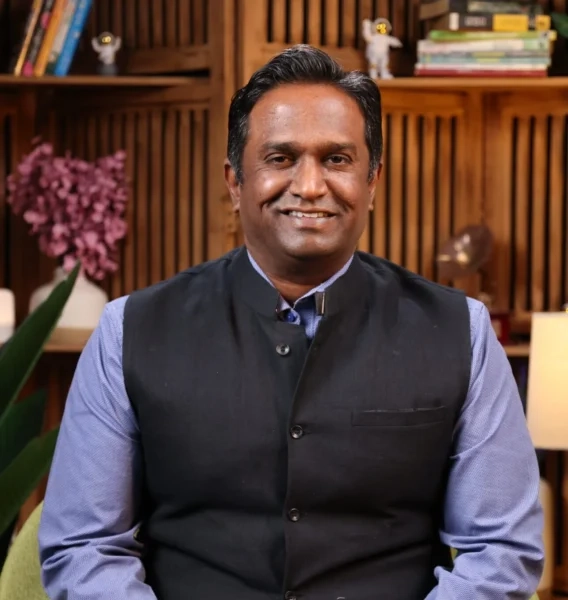
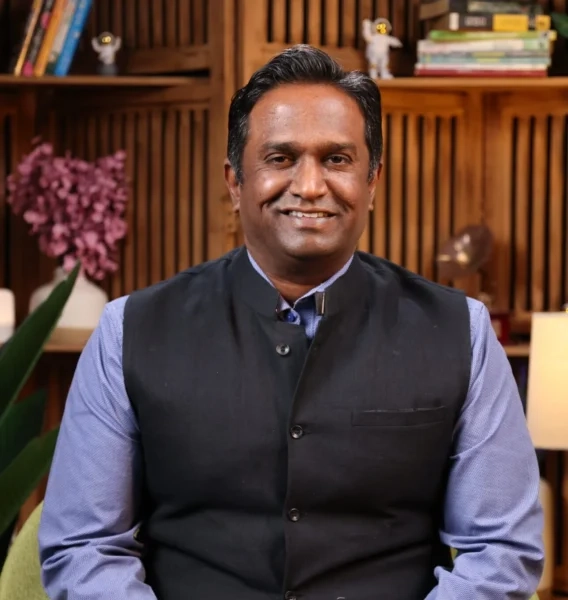
Dr. Vishwas Ghatge

Dr. Vishwas Ghatge

BAMS · MD Ayurveda · Founder

15+ years of clinical practice in Nadi Pariksha and Ayurvedic treatment of skin diseases including psoriasis, eczema and vitiligo.

Overview

What is Psoriasis?

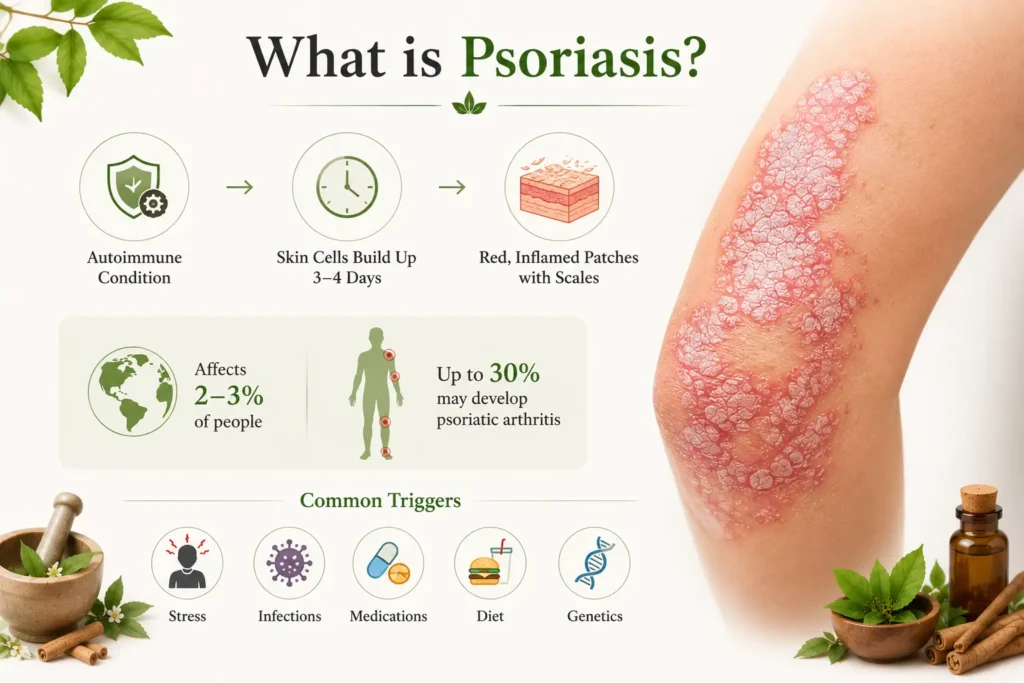
Psoriasis is a chronic, non-contagious autoimmune skin disease in which the immune system mistakenly accelerates the skin cell lifecycle. Normal skin cells complete their growth cycle in about a month — in psoriasis, this can happen in just 3–4 days. The rapid buildup of skin cells creates the characteristic raised, red patches covered with silvery-white scales known as plaques.

Psoriasis affects approximately 2–3% of the global population and can appear at any age. It is not merely a skin condition — it reflects a systemic imbalance that, when left unaddressed, can progress to psoriatic arthritis (joint involvement) in up to 30% of cases. It follows a cycle of flares and remissions, with triggers including stress, infections, certain medications and dietary factors.

Key insight : Psoriasis is not contagious. It cannot spread through touch, water, or any form of contact. Patients at Ayurvishwa Healthcare are treated with this understanding — the condition is internal, not superficial.

What causes psoriasis?

Modern medicine identifies psoriasis as an autoimmune condition with genetic predisposition — T-cells mistakenly attack healthy skin cells, triggering rapid turnover. Common triggers include:

Stress and emotional disturbance — among the most consistent triggers across patients

Infections — particularly streptococcal throat infections (trigger for guttate psoriasis)

Medications — lithium, antimalarials, beta-blockers and some blood pressure drugs

Skin injury — cuts, burns, insect bites (Koebner phenomenon)

Smoking and alcohol — both worsen severity and frequency of flares

Diet — processed foods, excess sugar, red meat and incompatible food combinations

Recognition

Psoriasis Symptoms

In Ayurveda, psoriasis is most closely aligned with Ekakushtha — one of the eleven Mahakushtha (major skin disorders) described in the Charaka Samhita. The name itself describes its appearance: Eka (solitary/spreading) and Kushtha (skin disease). Classical texts describe Ekakushtha as resembling the skin of a fish (Matsya Shakalopanam) — a remarkably accurate description of psoriatic scaling.

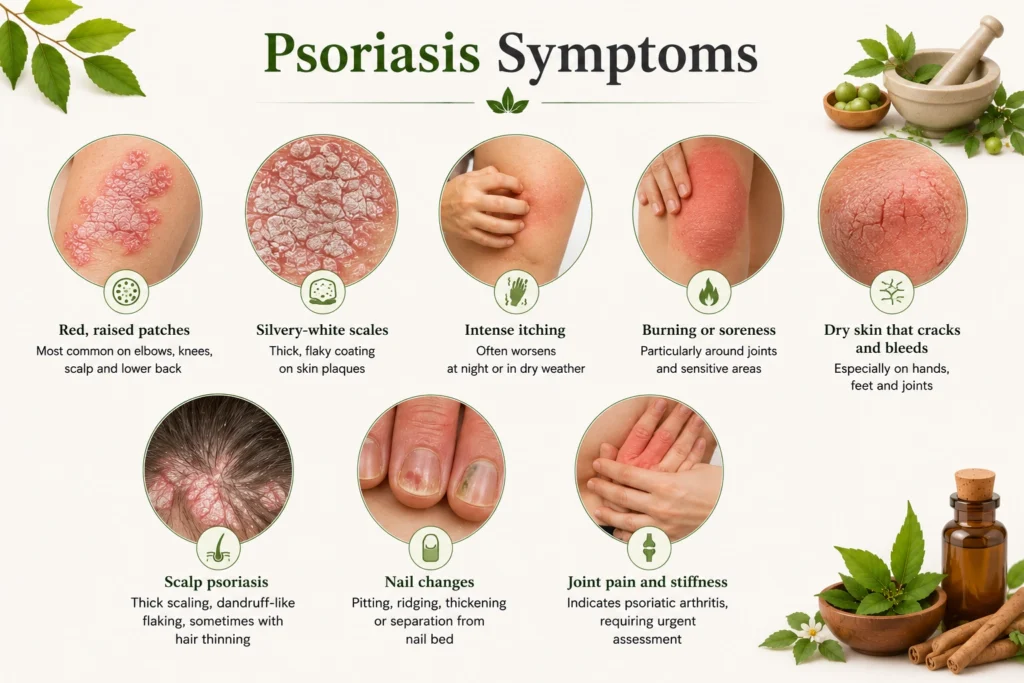
Red, raised patches — inflamed skin plaques, most common on elbows, knees, scalp and lower back

Silvery-white scales — thick, flaky coating on skin plaques

Intense itching — often worsens at night or in dry weather

Burning or soreness — particularly around joints and sensitive areas

Dry skin that cracks and bleeds — especially on hands, feet and joints

Scalp psoriasis — thick scaling, dandruff-like flaking, sometimes with hair thinning

Nail changes — pitting, ridging, thickening or separation from nail bed

Joint pain and stiffness — indicates psoriatic arthritis, requiring urgent assessment

Classification

Types of Psoriasis

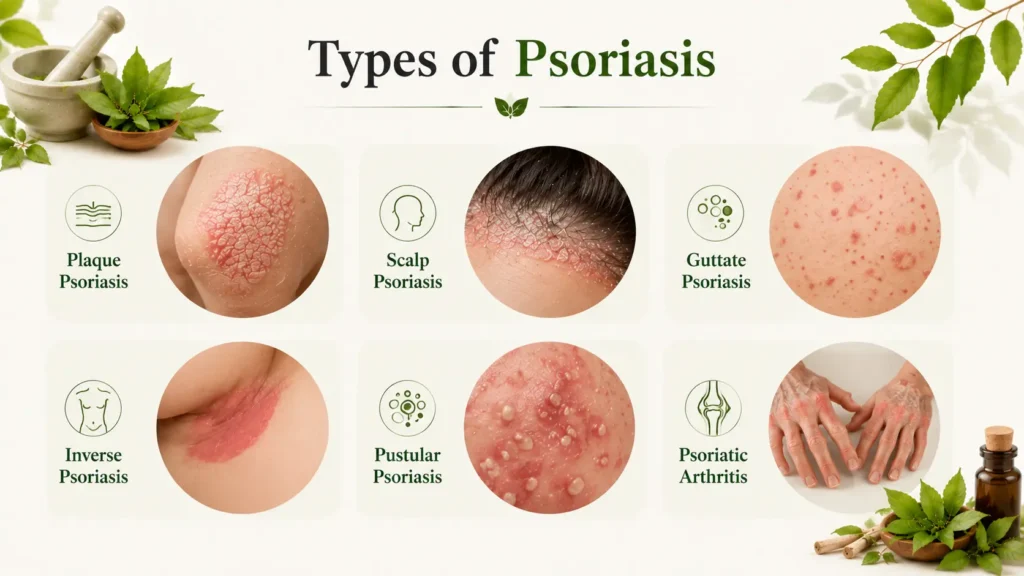
Psoriasis presents in several distinct forms. Nadi Pariksha at Ayurvishwa Healthcare identifies the dosha-specific pattern of each type, enabling targeted treatment.

The dosha analysis of psoriasis

Ayurvedic Perspective

Psoriasis in Ayurveda — Ekakushtha

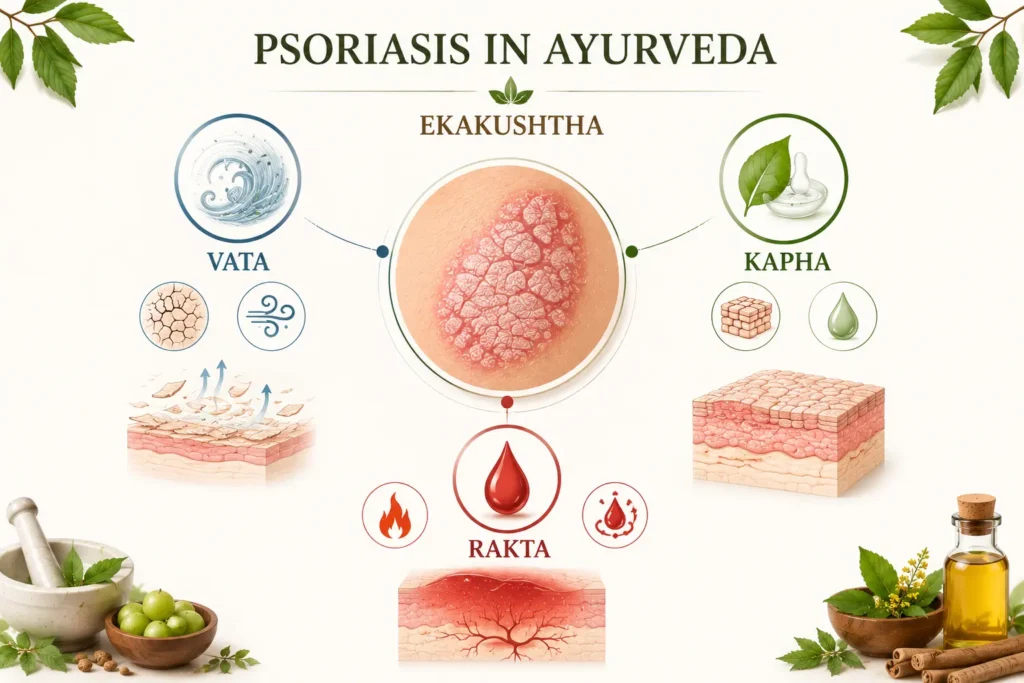
In Ayurveda, psoriasis is most closely aligned with Ekakushtha — one of the eleven Mahakushtha (major skin disorders) described in the Charaka Samhita. The name itself describes its appearance: Eka (solitary/spreading) and Kushtha (skin disease). Classical texts describe Ekakushtha as resembling the skin of a fish (Matsya Shakalopanam) — a remarkably accurate description of psoriatic scaling.

Root causes in Ayurvedic understanding

According to Ayurvedic classical texts, Kushtha Roga — including Ekakushtha — arises from a combination of:

Compromised Agni (digestive fire) — inadequate digestion leads to Ama (undigested toxin) formation, the root driver of most chronic diseases

Viruddha Ahara (incompatible diet) — consuming foods that conflict with one’s constitution or each other vitiates all three doshas simultaneously

Suppression of natural urges — particularly those affecting the skin’s natural detoxification through sweat

Mental and emotional factors (Manasika) — unresolved stress and emotional disturbance vitiate Vata, initiating a cascade affecting Rakta and Twak (skin tissue)

Diagnosis at Ayurvishwa Healthcare

How Nadi Pariksha Diagnoses Psoriasis

In Ayurveda, psoriasis is most closely aligned with Ekakushtha — one of the eleven Mahakushtha (major skin disorders) described in the Charaka Samhita. The name itself describes its appearance: Eka (solitary/spreading) and Kushtha (skin disease). Classical texts describe Ekakushtha as resembling the skin of a fish (Matsya Shakalopanam) — a remarkably accurate description of psoriatic scaling.

01

Pulse reading — three positions, three doshas

Dr. Ghatge reads the pulse at three wrist positions, each corresponding to Vata, Pitta and Kapha. For psoriasis, the pulse typically reveals a Vata-Kapha dominance pattern with secondary Rakta vitiation — but the precise ratio and depth of imbalance varies significantly between patients.

02

Prakruti assessment

Your body constitution (Prakruti) is assessed alongside the current imbalance (Vikruti). This distinction is critical — a Vata-dominant Prakruti patient with psoriasis requires a fundamentally different prescription than a Kapha-dominant patient with an identical-looking skin presentation.

03

Ama and Agni evaluation

The pulse also reveals the state of Agni (digestive fire) and the presence and depth of Ama (toxin accumulation). In most psoriasis cases, Ama is present across multiple tissue levels — treatment must address this in the correct sequence for lasting results.

04

Personalised medicine prescribed

Based on the pulse findings, Dr. Ghatge prescribes a personalised Ayurvedic medicine plan — dispensed from your nearest Ayurvishwa Healthcare clinic. Medicines are never generic or off-the-shelf. They are formulated specifically for your dosha pattern, Prakruti and disease stage.

Treatment Approach

Ayurvedic Psoriasis Treatment at Ayurvishwa Healthcare

Ayurvishwa Healthcare’s approach to psoriasis treatment in Ayurveda follows a structured protocol — targeting the root dosha imbalance, clearing Ama, restoring Agni and supporting Rakta purification simultaneously. Treatment is entirely personalised based on Nadi Pariksha findings.

Treatment pillars

Shodhana (purification) — clearing Ama from tissues and channels using targeted Ayurvedic formulations that match the patient’s dosha pattern and disease stage

Shamana (pacification) — correcting the underlying Vata-Kapha imbalance using oral Ayurvedic medicines. Specific herbs target Rakta vitiation and support Twak (skin tissue) regeneration

Agni deepana (digestive restoration) — restoring the digestive fire is non-negotiable in psoriasis treatment. Without it, Ama will continue to accumulate regardless of other interventions

Rasayana (rejuvenation) — once the system is cleared and doshas are balanced, specific Rasayana formulations support skin tissue regeneration and long-term immune stability

Ahara and Vihara (diet and lifestyle) — personalised dietary guidance identifying foods to include and avoid based on your Prakruti, and lifestyle adjustments to reduce known triggers

Psoriasis treatment vs Conventional approach

ASPECT AYURVEDIC APPROACH (AYURVISHWA) CONVENTIONAL APPROACH
Goal Root-cause correction — dosha balance, Ama clearance Symptom suppression — reduce plaque and inflammation
Diagnosis Nadi Pariksha — identifies specific dosha pattern Visual examination, biopsy, clinical criteria
Treatment Personalised Ayurvedic medicines, diet, lifestyle Topical steroids, immunosuppressants, biologics
Side effects Minimal when correctly prescribed for your Prakruti Skin thinning, immune suppression, systemic effects
Duration 2–12 months depending on severity and chronicity Ongoing — most conventional treatments manage, not cure
Scalp psoriasis Specific Shiro protocol alongside systemic treatment Medicated shampoos, topical steroids, UV light

Important: Results of Ayurvedic treatment vary based on disease chronicity, individual Prakruti, compliance with dietary guidance and regularity of treatment. This table is for general educational comparison — it does not constitute a treatment recommendation. Please consult Dr. Ghatge for a personalised assessment.

“Your psoriasis has a root cause. Let us find it.”

Dr. Vishwas Ghatge, BAMS · MD Ayurveda
Qualification BAMS · MD Ayurveda
Experience 15+ Years
Patients Treated 1 Lakh+
Speciality Nadi Pariksha
Clinics 14 · Maharashtra