Obesity Ayurvedic
Treatment

Kapha-Meda root-cause treatment — not just weight management

Obesity treatment in Ayurveda addresses the root metabolic imbalance — not calories alone. Called Sthaulya or Medoroga in classical texts, obesity is a Kapha-dominant disorder of Meda Dhatu (fat tissue) and impaired Agni. At Ayurvishwa Healthcare, Dr. Vishwas Ghatge (BAMS · MD Ayurveda), the trusted doctor for obesity treatment in Maharashtra, uses Nadi Pariksha to identify your exact doshic pattern — covering general obesity, abdominal obesity treatment and childhood obesity treatment — and prescribes a personalised Ayurvedic protocol to correct it.
Book a Consultation Find Clinic Near You
Ayurvedic Clinic in Sambhajinagar

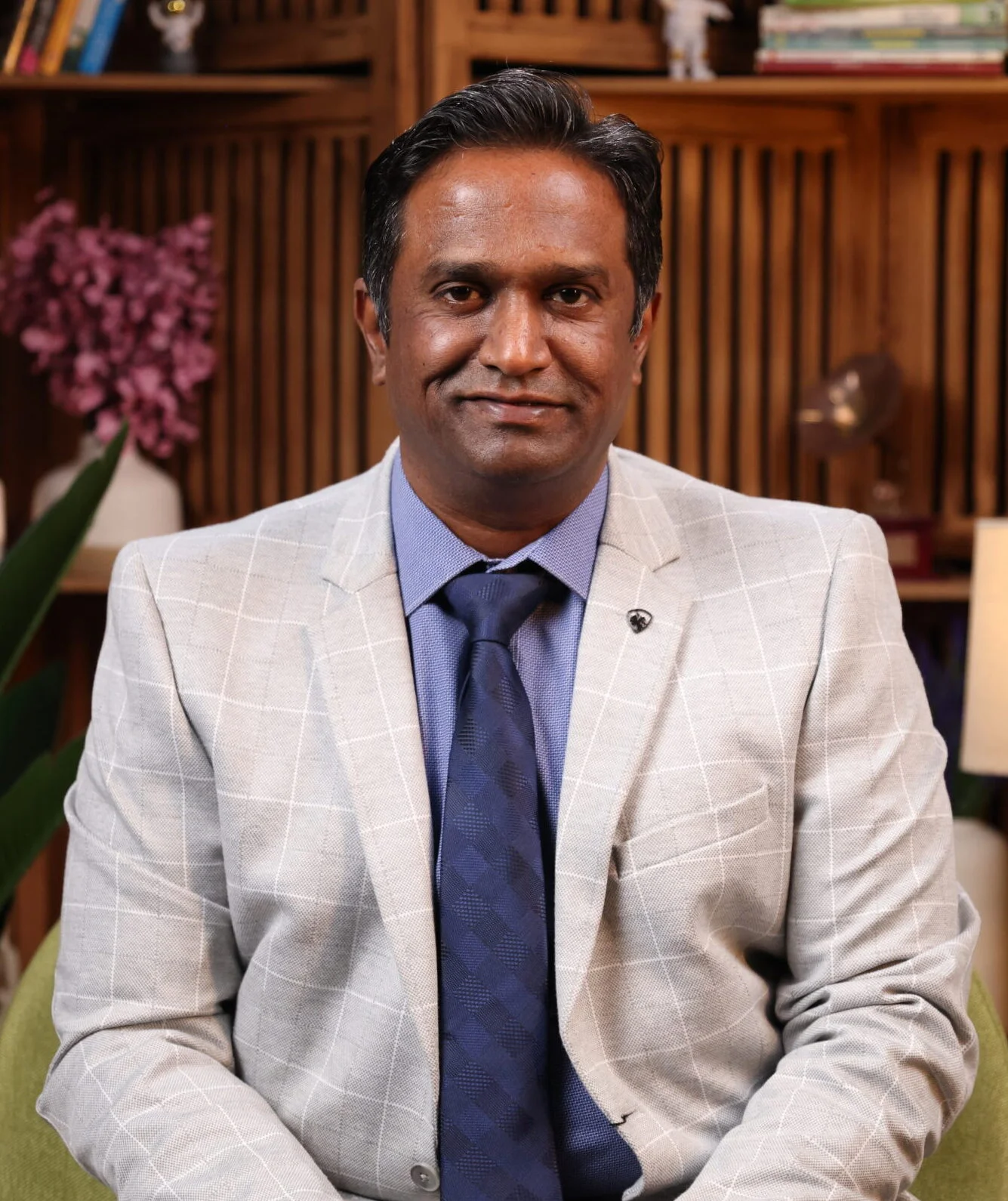
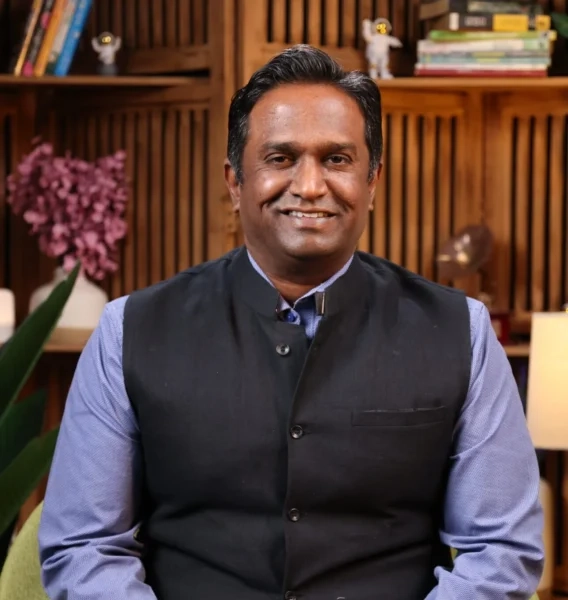
Dr. Vishwas Ghatge

BAMS · MD Ayurveda · Founder
  • Identifies Kapha-Meda pattern through Nadi Pariksha — root cause of your obesity
  • Covers abdominal obesity treatment and childhood obesity treatment
  • 14 clinics across Maharashtra · Personalised obesity ayurvedic treatment
Book Online Consultation Visit Our Clinic

Ayurvishwa Healthcare offers personalised Ayurvedic obesity treatment using Nadi Pariksha to identify the root cause of weight gain. The treatment focuses on balancing Kapha, improving metabolism, and reducing excess fat through customised medicines, diet, and lifestyle guidance. Special care is available for abdominal obesity, childhood obesity, PCOS, and thyroid-related weight issues.

What is Obesity?

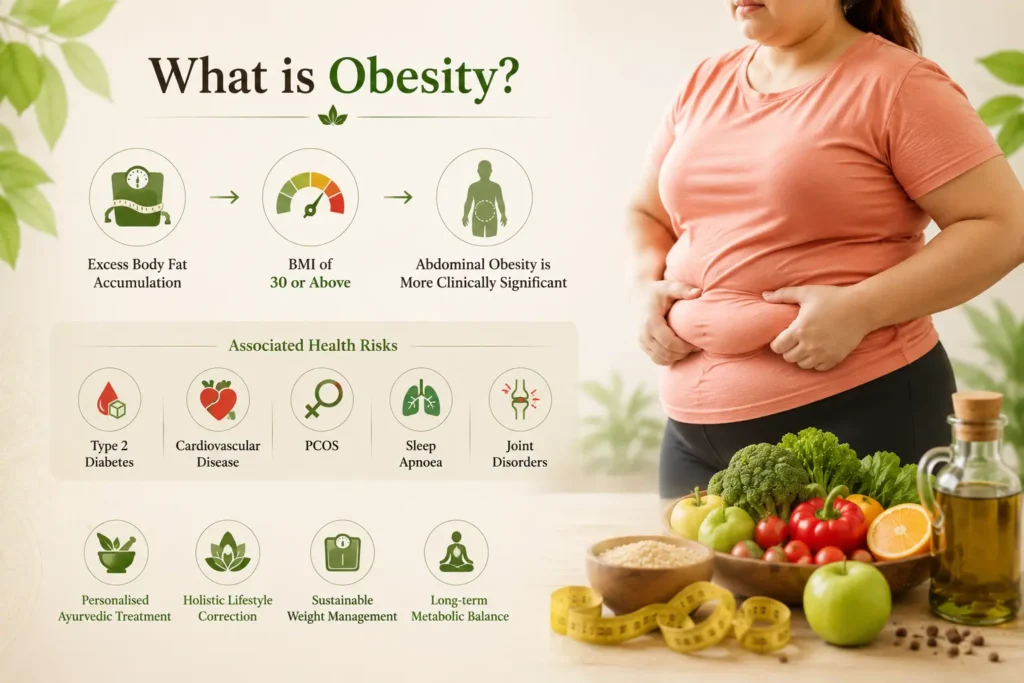
Obesity is a chronic metabolic condition characterised by excess accumulation of body fat to a degree that may impair health. It is defined as a Body Mass Index (BMI) of 30 or above, though the distribution of fat — particularly abdominal obesity — is often more clinically significant than BMI alone. Obesity treatment is one of the most sought-after areas in preventive medicine today, as obesity is a primary risk factor for type 2 diabetes, cardiovascular disease, PCOS, sleep apnoea and joint disorders.

In India, obesity prevalence has more than doubled in the last two decades. Childhood obesity is now a major public health concern, with an estimated 14.4 million children classified as obese — the second-highest number globally. Despite its prevalence, conventional obesity treatment approaches — calorie restriction, exercise and medication — address symptoms rather than the underlying metabolic cause, which is why results are often temporary.

Ayurveda’s insight into obesity: Obesity ayurvedic treatment does not begin with a diet plan — it begins with Nadi Pariksha. The same amount of excess weight in two different patients may have entirely different root causes: one driven by Kapha-Ama, another by Vata-irregular metabolism, a third by hormonal Pitta. The treatment must match the cause — not just the number on the scale.

Signs & Symptoms of Obesity

Obesity presents as more than excess weight. The following symptoms are commonly seen across patients seeking obesity ayurvedic treatment at Ayurvishwa Healthcare — including both general obesity and abdominal obesity presentations:

When to consult a doctor for obesity treatment: If you have a BMI above 27.5 and any associated health condition — diabetes, hypertension, PCOS, sleep apnoea or joint pain — do not wait. Early obesity treatment significantly reduces the risk of these conditions worsening. Book a Nadi Pariksha consultation at Ayurvishwa Healthcare today.

What Causes Obesity?

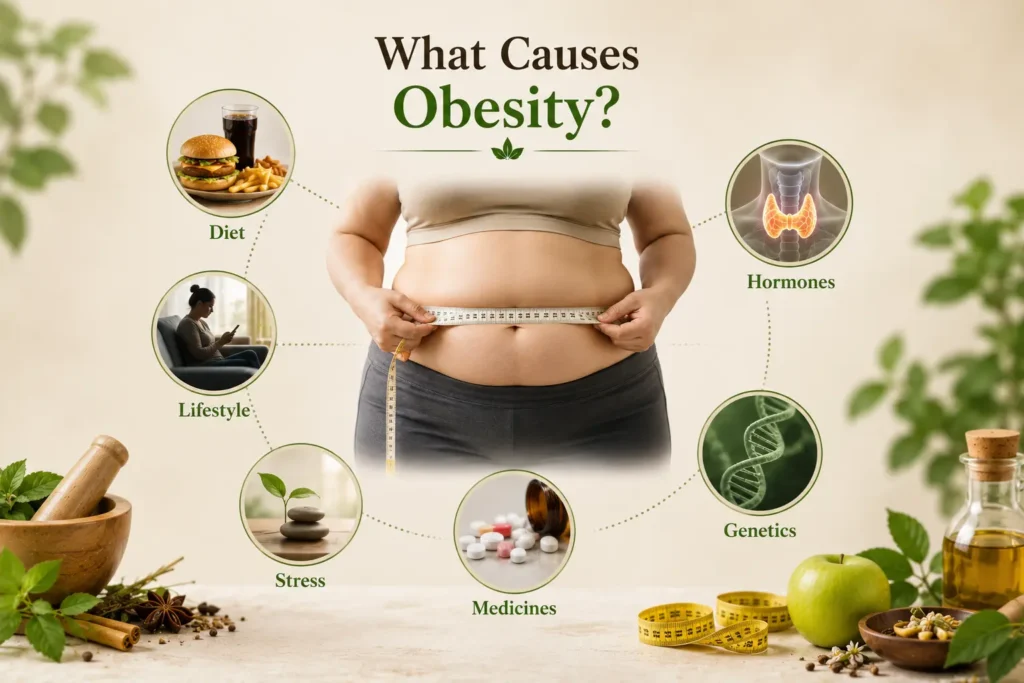
The causes of obesity are multi-factorial — which is why no single diet or exercise plan works for everyone. Identifying the specific contributing factors in each individual is the first task of a skilled doctor for obesity treatment. In Ayurveda, these are understood as Nidana (causative factors) that vitiate Kapha and impair Agni:

Types of Obesity — Ayurvedic Classification

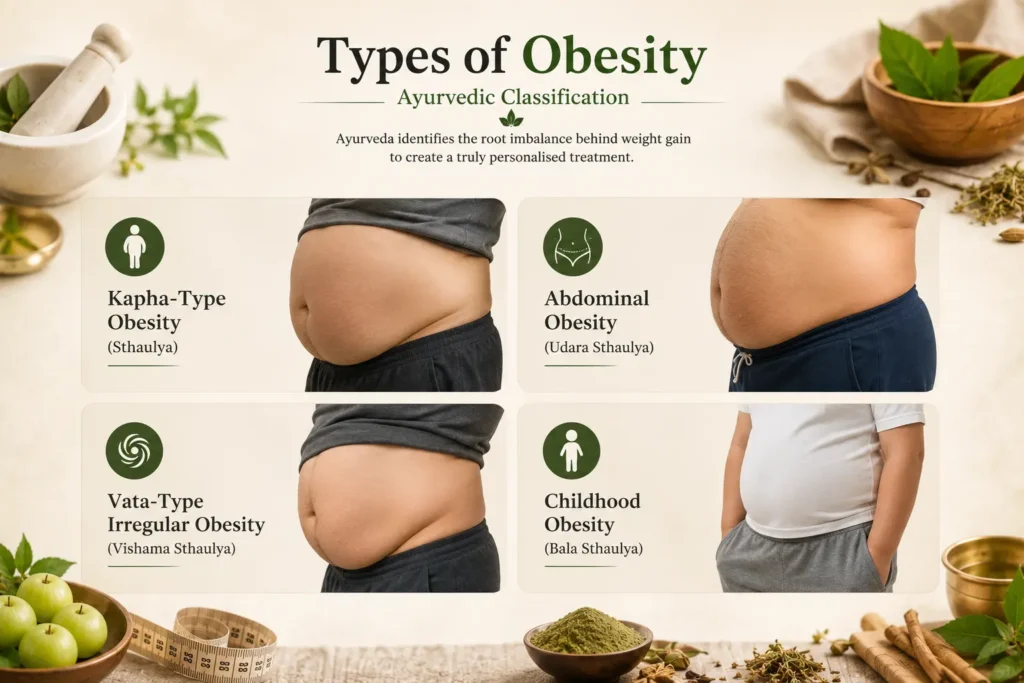
Modern medicine classifies obesity by BMI and fat distribution. Ayurveda goes deeper — identifying the doshic driver of each type, which determines the correct obesity ayurvedic treatment protocol. Dr. Ghatge’s Nadi Pariksha identifies which type a patient presents with before any treatment is prescribed.

How Ayurveda Understands Obesity — Sthaulya & Medoroga

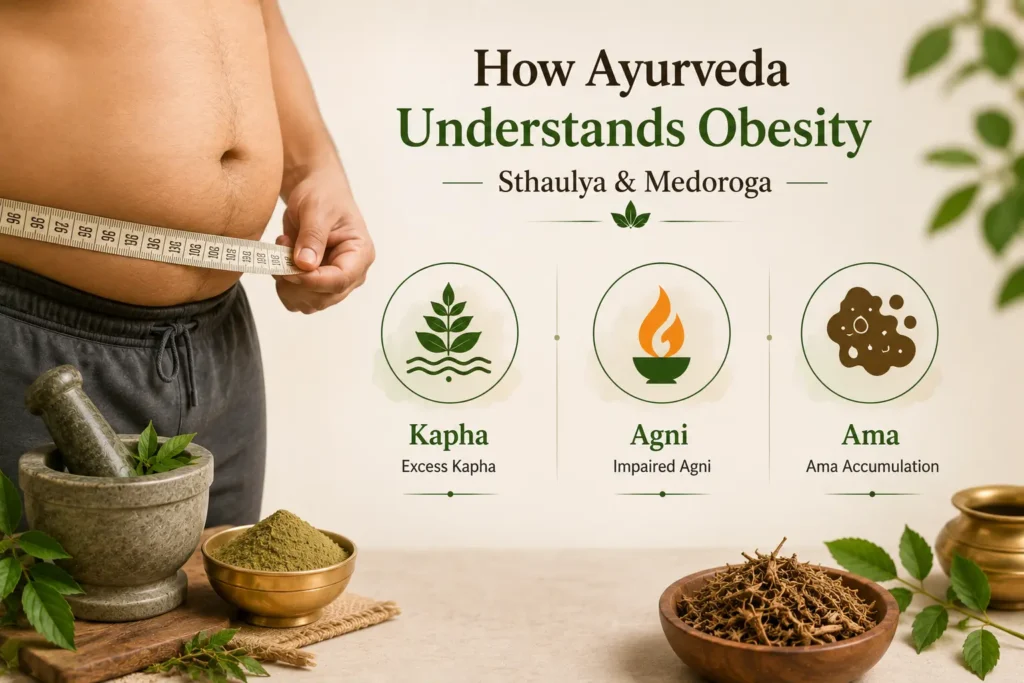
In classical Ayurveda, obesity is described as Sthaulya (corpulence) or Medoroga (disease of excess Meda/fat tissue) — listed among the Ashtau Nindita Sharira (eight undesirable body states) in the Charaka Samhita. It is defined as excess accumulation of Meda Dhatu (fat tissue) and Mamsa Dhatu (muscle), leading to a body that is heavy, soft and unable to perform optimal physiological functions.

Why the same obesity treatment fails different patients

The classical text states: “Ati sthaulyasya chikitsa langhana” — for the excessively obese, the treatment is lightening/reducing. But how to reduce — which herbs, which diet, which daily routine — depends entirely on the individual’s Prakruti, Agni type, Ama load and current doshic state. Two patients with the same BMI and same lifestyle may require completely different protocols. This is why Nadi Pariksha — not a generic obesity treatment plan — is the correct starting point.

Classical reference: The Charaka Samhita (Sutrasthana 21) identifies eight forms of Nindita Sharira (unfavourable body states) — with Ati Sthaulya (extreme obesity) at the top, listing shortened lifespan, reduced virility, impaired movement and foul body odour as its consequences. Ayurveda recognised obesity as a disease of excess, not a character flaw — and provided clear, systematic obesity treatment protocols 2,500 years ago.

How Nadi Pariksha Diagnoses Psoriasis

In Ayurveda, psoriasis is most closely aligned with Ekakushtha — one of the eleven Mahakushtha (major skin disorders) described in the Charaka Samhita. The name itself describes its appearance: Eka (solitary/spreading) and Kushtha (skin disease). Classical texts describe Ekakushtha as resembling the skin of a fish (Matsya Shakalopanam) — a remarkably accurate description of psoriatic scaling.

Nadi Pariksha in Obesity Diagnosis

Nadi Pariksha is the primary diagnostic tool used by Dr. Vishwas Ghatge — the most experienced doctor for obesity treatment through Ayurveda in Maharashtra — before any obesity ayurvedic treatment protocol is prescribed. The pulse reading takes 15–20 minutes and reveals what no scale or BMI chart can: the exact doshic pattern, Agni state, Ama load and organ-system contribution to each patient’s obesity.

Aspect Generic Obesity Protocol Nadi Pariksha Approach
Starting point BMI + calorie calculation Pulse reading — 15–20 min clinical assessment
Diagnosis depth Obesity as one condition Identifies Kapha type, Agni state, Ama load, organ contribution
Treatment Same diet for all patients Fully personalised — no two patients get the same plan
Medicines Standard supplement stack Classical herbs selected for individual doshic picture
Abdominal obesity Core exercises + calorie deficit Targeted Medohara formulations for Koshtha fat specifically
Childhood obesity Calorie restriction Age-appropriate Kapha management without aggressive intervention

With over 1 lakh Nadi Pariksha sessions, Dr. Ghatge has a depth of pulse-reading precision that allows him to identify the precise combination of Kapha, Agni and Ama driving each patient’s obesity — including distinguishing between primary obesity (lifestyle-driven) and secondary obesity (hormonal, medication-related or Vata-type). This precision is what makes obesity ayurvedic treatment at Ayurvishwa fundamentally different from a generic weight-loss programme.

Obesity Ayurvedic Treatment at Ayurvishwa Healthcare

The obesity ayurvedic treatment protocol at Ayurvishwa Healthcare is entirely personalised, built on Nadi Pariksha findings. There is no standard “weight loss package.” Every component — medicine, diet, lifestyle and review timeline — is determined after pulse assessment by Dr. Vishwas Ghatge, the most experienced doctor for obesity treatment through Nadi Pariksha in Maharashtra.

1. Nadi Pariksha — Root-Cause Identification

Dr. Ghatge reads the pulse for 15–20 minutes to identify the specific Kapha-Meda pattern, Agni type (Manda, Vishama or Sama), degree of Ama accumulation, Medovaha Srotas status and any associated hormonal or organ imbalances contributing to obesity. This forms the foundation of the entire obesity treatment plan.

2. Prakruti Parikshan — Constitution Assessment

Understanding the patient’s inherent Prakruti distinguishes constitutional Kapha (natural body type) from the current Kapha excess driving obesity. A Kapha-dominant Prakruti requires a different protocol to a Vata-dominant Prakruti with secondary Kapha imbalance. This prevents over-treatment and ensures the obesity ayurvedic treatment is sustainable.

3. Ama Pachana — Metabolic Toxin Clearance

Before Meda-reduction can begin effectively, Ama blocking the Medovaha Srotas must be cleared. Ama Pachana herbs are prescribed first — targeting sluggish digestion, reducing inflammatory metabolic waste and opening the channels for Meda to be metabolised. This phase is often neglected in generic obesity treatment but is critical in Ayurveda.

4. Medohara Chikitsa — Targeted Fat Reduction

Personalised Medohara (fat-reducing) herbal formulations are prescribed based on Nadi Pariksha findings — targeting either generalised obesity or specifically abdominal obesity treatment depending on the fat distribution pattern. Herbs are selected for their Kapha-reducing, Agni-stimulating and Srotas-cleansing properties.

5. Ahara & Vihara — Personalised Diet & Lifestyle

A Prakruti-specific dietary plan and daily routine (Dinacharya) are prescribed as integral parts of the obesity treatment — not optional additions. This includes specific foods, meal timings, movement routines and sleep hygiene aligned to the patient’s doshic state.

6. Regular Review via Nadi Pariksha

At each follow-up, Dr. Ghatge re-reads the pulse to track changes in Agni, Ama load and Meda state — adjusting the herbal protocol and dietary guidance accordingly. Obesity ayurvedic treatment typically runs 3–12 months, reviewed every 4–6 weeks.

Classical Ayurvedic herbs used in obesity treatment

Triphala — The foundational tridoshic formulation. Corrects Agni, reduces Ama, gently cleanses Medovaha Srotas and supports elimination without depleting Dhatu. Central to most obesity ayurvedic treatment protocols.

Guduchi (Tinospora cordifolia) — Reduces Ama, supports Agni, calms systemic inflammation and corrects metabolic dysfunction. Particularly useful in Pitta-Kapha obesity presentations with inflammatory components.

Punarnava (Boerhavia diffusa) — Classical Kapha-reducing and diuretic herb. Reduces Meda accumulation and water retention; useful in abdominal obesity treatment with oedematous presentations.

Varuna (Crataeva nurvala) — Referenced in classical texts for Kapha-Meda reduction. Used in protocols targeting abdominal fat accumulation and metabolic sluggishness.

Haritaki (Terminalia chebula) — Tri-doshic Rasayana with strong Agni-stimulating and Ama-clearing properties. Used as part of Triphala and independently in obesity treatment where Agni correction is the primary need.

Vidanga (Embelia ribes) — Referenced for Kapha-Meda management and metabolic activation. Used in specific obesity ayurvedic treatment formulations targeting sluggish fat metabolism

Important: None of the herbs above should be self-administered for obesity treatment. Ayurvedic herbal medicine must always be prescribed by a qualified physician after clinical assessment. The formulation, dose and combination are entirely individualised — the same herb can have opposite effects when prescribed incorrectly.

Diet & Lifestyle in Obesity Ayurvedic Treatment

In Ayurveda, Ahara (diet) and Vihara (lifestyle) are not supplementary to obesity treatment — they are inseparable from it. The following general principles apply to most Kapha-dominant obesity presentations. All guidance at Ayurvishwa Healthcare is fully personalised to each patient’s Prakruti:

Dietary principles for Kapha-type obesity

Favour light, warm, dry and spiced foods — cooked vegetables, lentils, millet, barley and warming spices (ginger, black pepper, long pepper, turmeric) stimulate Agni and reduce Kapha-Meda

Reduce or avoid heavy, cold, sweet and oily foods — these directly aggravate Kapha and increase Meda formation; reduce dairy, white rice, refined flour, processed foods and cold beverages

Eat the main meal at midday — Agni is strongest between 10am and 2pm; eating the largest meal at this time aligns with peak metabolic fire and reduces Meda accumulation

Avoid eating after sunset — Agni weakens after sunset; evening eating generates Ama and increases fat storage, directly driving abdominal obesity

Drink warm water throughout the day — warm water (Ushna Jala) is specifically recommended in Sthaulya management; stimulates Agni, reduces Kapha and aids Meda metabolism

Lifestyle and Dinacharya for obesity management

Avoid daytime sleeping (Divaswapna) — specifically contraindicated in Sthaulya in the Charaka Samhita; directly increases Kapha and Meda and worsens obesity

Regular vigorous physical movement — for Kapha-dominant obesity, movement must be consistent and ideally vigorous; morning walks, surya namaskar and resistance exercises are recommended

Early rising (Brahma Muhurta) — rising before sunrise aligns the body with Vata’s natural activity phase, stimulating metabolism and reducing Kapha accumulation before the day begins

Stress management — for abdominal obesity treatment specifically, cortisol management is critical; visceral fat accumulation is strongly stress-driven and requires consistent nervous system regulation

Childhood Obesity Treatment at Ayurvishwa Healthcare

Childhood obesity treatment is one of the most important areas of preventive medicine in India today. With 14.4 million obese children, the metabolic consequences — insulin resistance, fatty liver, early hypertension and hormonal disruption — are being seen at increasingly young ages. Conventional childhood obesity treatment often relies on calorie restriction, which is inappropriate for growing children.

The Ayurvedic approach to childhood obesity

Ayurvedic childhood obesity treatment at Ayurvishwa Healthcare follows the same Nadi Pariksha-based diagnostic approach but is adapted entirely to the child’s age, stage of development and Prakruti. The protocol avoids aggressive fat-burning herbs that would be inappropriate for a growing body and focuses instead on:

Agni correction and Ama clearance — the primary goal in most childhood obesity presentations; gentle Agni-stimulating herbs appropriate for children are prescribed after Nadi Pariksha assessment

Family dietary correction — childhood obesity treatment is not effective without addressing the family food environment; dietary guidance is given to the entire household

Movement and sleep guidance — consistent physical activity and regulated sleep timings are core childhood obesity treatment components; screen time reduction is explicitly addressed

Prakruti-appropriate Kapha management — for Kapha-Prakriti children, gentle long-term Kapha-reducing dietary and lifestyle guidance supports healthy weight management without deprivation

Emotional and stress support — childhood obesity is increasingly linked to emotional eating and stress; Ayurvedic Manovaha Srotas support is included in the treatment plan

At Ayurvishwa Healthcare: All childhood obesity treatment protocols are conducted with both parent and child present. Dr. Ghatge performs Nadi Pariksha on the child and explains the findings to the parent in clear language — ensuring the family understands and can implement the guidance at home. Treatment typically begins showing results within 2–3 months with consistent compliance.

“Obesity starts with Kapha. Treatment starts with the pulse.”

book appointment
ayurvedic clinic in kandivali​ ayurvedic clinic in kandivali west​

Dr. Vishwas Ghatge

Qualification BAMS · MD Ayurveda
Experience 15+ Years
Patients 1 Lakh+
Speciality Nadi Pariksha
Clinics 14 · Maharashtra
Related Conditions
Our Clinics

First appointment within 48 hours. Online & offline available.

Hear from obesity patients at Ayurvishwa Healthcare

Real patients. Real results. Watch their obesity treatment journeys — shared directly on the Ayurvishwa Healthcare YouTube channel. Individual outcomes vary.

“Dr. Ghatge’s Nadi Pariksha found the root of my weight problem — not just a diet plan”

Obesity Treatment / Pune

“My abdominal obesity was linked to diabetes — Dr. Ghatge treated both together through Nadi Pariksha”

Abdominal Obesity Treatment / Mumbai

“My son’s childhood obesity was addressed without harsh restriction — gentle Ayurvedic approach worked beautifully”

Childhood Obesity Treatment / Nashik
View All Patient Videos on YouTube

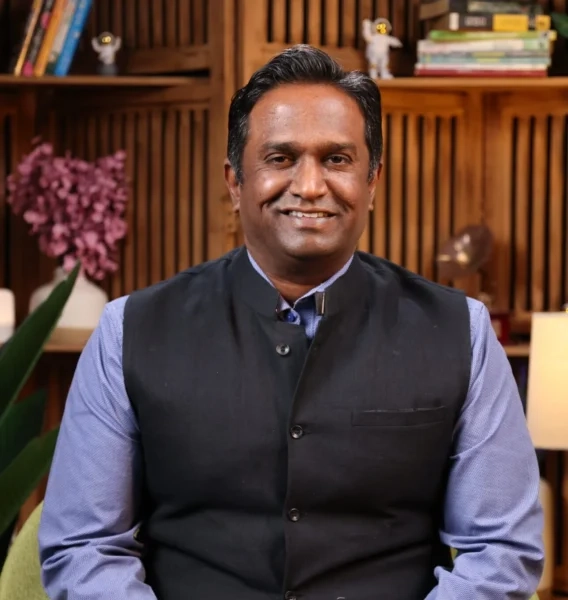
Dr. Vishwas Ghatge

BAMS · MD Ayurveda · Founder, Ayurvishwa Healthcare

Dr. Vishwas Ghatge is one of India’s most experienced Nadi Pariksha practitioners and the founder of Ayurvishwa Healthcare. He is the preferred doctor for obesity treatment through classical Ayurveda in Maharashtra — with a clinical approach built on 15+ years of practice and over 1 lakh Nadi Pariksha sessions.

His obesity ayurvedic treatment approach covers generalised obesity, abdominal obesity treatment, hormonal obesity linked to PCOS and thyroid, and childhood obesity treatment — always through personalised Nadi Pariksha diagnosis. No two patients receive the same obesity treatment protocol at Ayurvishwa Healthcare.

BAMS
Ayurvedic Medicine
MD
MD Ayurveda

15+
Years Practice

1 L+
Patients Treated

Full Doctor Profile Watch on YouTube
Ayurvedic Clinic in Nanded

Obesity is not a willpower failure — it is a Kapha-Meda imbalance that requires a precise prescription, not a generic diet. The pulse tells me exactly what is needed. No two patients with the same weight need the same treatment.

Dr. Vishwas Ghatge, BAMS · MD Ayurveda · Founder, Ayurvishwa Healthcare

Visit Us

14 clinics across Maharashtra

Walk in or book ahead at any Ayurvishwa Healthcare clinic for your Nadi Pariksha consultation with Dr. Ghatge.

View All Clinics

Start Your Obesity Treatment Today

Book a Nadi Pariksha consultation with Dr. Vishwas Ghatge — the most experienced doctor for obesity treatment through classical Ayurveda in Maharashtra. Available in-clinic across 14 locations. Childhood obesity treatment and abdominal obesity treatment consultations also available.

Book Your Appointment

We confirm within 2 hours · Mon–Sat

    Obesity Ayurvedic Treatment —
    Common Questions

    About obesity treatment, abdominal obesity treatment, childhood obesity treatment and how Ayurvishwa Healthcare treats obesity.

    Have a question not answered here? Call us or book a consultation — our team will guide you.

    Book consultation

    Obesity ayurvedic treatment addresses the root Kapha-Meda dosha imbalance — not just calorie restriction. At Ayurvishwa Healthcare, Dr. Vishwas Ghatge uses Nadi Pariksha to identify your specific dosha pattern (Sthaulya/Medoroga) and prescribes personalised Ayurvedic medicine, dietary corrections and lifestyle guidance to reduce excess Meda progressively and sustainably. Results vary by individual.

    A good doctor for obesity treatment should assess the root metabolic cause — not just prescribe a diet plan. Dr. Vishwas Ghatge (BAMS · MD Ayurveda) at Ayurvishwa Healthcare uses Nadi Pariksha to identify the underlying doshic pattern, Agni type and Ama load driving each patient’s obesity, then prescribes a fully personalised Ayurvedic obesity treatment protocol. He is experienced in general obesity treatment, abdominal obesity treatment and childhood obesity treatment.

    Abdominal obesity treatment in Ayurveda addresses excess Meda accumulation in the Koshtha (abdominal region) — driven by Kapha and aggravated Apana Vata imbalance. Dr. Ghatge prescribes specific Medohara (fat-reducing) formulations, Agni-stimulating herbs and personalised dietary protocols targeting abdominal obesity after Nadi Pariksha diagnosis. Abdominal obesity carries the highest metabolic risk, making early targeted abdominal obesity treatment essential.

    Yes. Childhood obesity treatment at Ayurvishwa Healthcare follows the same Nadi Pariksha-based approach with age-appropriate herbal formulations, dietary guidance and lifestyle corrections for children. Gentle Agni correction and Kapha management through diet and movement form the basis of childhood obesity treatment in Ayurveda — without calorie restriction inappropriate for growing children. Dr. Ghatge’s childhood obesity treatment involves parents as active participants in the process.

    Sthaulya (also Medoroga) is the classical Ayurvedic description of obesity — characterised by excess Meda Dhatu (fat tissue) accumulation due to impaired Agni, Kapha dominance and Ama blocking the Medovaha Srotas. It is listed among the eight Nindita Sharira (undesirable body states) in the Charaka Samhita. All obesity ayurvedic treatment at Ayurvishwa Healthcare is based on classical Sthaulya Chikitsa protocols.

    Duration varies. Mild obesity with good Agni and compliance typically shows improvement in 3–4 months. Moderate to severe obesity or longstanding metabolic dysfunction requires 6–12 months. Childhood obesity treatment typically begins showing results within 2–3 months. For abdominal obesity treatment, initial improvements in waist measurement are often seen within 2 months when diet compliance is maintained. Dr. Ghatge sets realistic timelines after Nadi Pariksha and reviews progress regularly.

    Yes. Obesity treatment linked to hypothyroidism, PCOS or insulin resistance is handled at Ayurvishwa Healthcare by addressing both the obesity and the underlying hormonal condition simultaneously through Nadi Pariksha. Dr. Ghatge identifies all contributing dosha imbalances — the obesity treatment protocol addresses the complete picture together, which is more effective than treating each condition in isolation.

    Yes. Childhood obesity treatment at Ayurvishwa Healthcare uses age-appropriate, gentle herbal formulations. Dr. Ghatge tailors the childhood obesity treatment protocol to the child’s age, Prakruti and specific presentation. Dietary and lifestyle guidance is a central component — childhood obesity treatment at Ayurvishwa always involves the family.

    Ayurveda specifically contraindicates daytime sleeping (Divaswapna) in obesity treatment. Warm water drinking, light warm meals, regular vigorous movement, early rising and avoidance of cold/heavy/sweet foods are the core lifestyle recommendations in Sthaulya management. For abdominal obesity treatment, stress management is added — cortisol management is critical for visceral fat. All guidance is personalised to the patient’s Prakruti at Ayurvishwa Healthcare.

    Nadi Pariksha allows Dr. Vishwas Ghatge to identify the specific Kapha-Meda pattern driving obesity, assess the state of Agni and Ama load, identify associated organ-system imbalances and distinguish between different obesity treatment presentations — including abdominal obesity, hormonal obesity and childhood obesity. No two patients with the same weight receive the same obesity ayurvedic treatment plan — the pulse determines the protocol.

    Related metabolic & hormonal conditions

    Your Kapha-Meda pattern is the cause. Nadi Pariksha is the answer.

    Book an obesity treatment consultation with Dr. Vishwas Ghatge — the trusted doctor for obesity treatment through Ayurveda in Maharashtra. Obesity ayurvedic treatment, abdominal obesity treatment and childhood obesity treatment available at 14 clinics across Maharashtra.

    Book Online Find Clinic