

Summary: One week your stomach feels tight and you barely go. The next week you are running to the washroom after every meal. That back and forth is one of the most commonly misread patterns in digestive health, because it looks like two separate problems and gets treated as two separate problems.
This guide explains what Irritable Bowel Syndrome actually is, why the pattern keeps flipping instead of settling, what Ayurveda calls this condition and why that framing changes the treatment, and what a doctor-guided plan realistically involves. We use general ranges and classical Ayurvedic terms rather than promises, because an honest picture is more useful to you than any clinic claiming a guaranteed cure.
You are not imagining it, and it is not simply stress in your head. There is a real, explainable mechanism behind it, and understanding that mechanism is the first step to calming it down.
Written and medically reviewed by Dr. Vishwas Ghatge, BAMS · MD Ayurveda, Founder of Ayurvishwa Healthcare, practising Nadi Pariksha–led Ayurvedic medicine for 18+ years. Last reviewed [ADD DATE].
IBS Patterns at a Glance
IBS-D · Diarrhoea predominant
Loose or watery stools with urgency, often soon after eating. Pitta with Vata.
IBS-C · Constipation predominant
Hard, infrequent stools with straining and a sense of incomplete emptying. Vata dominant.
IBS-M · Mixed pattern
Both, alternating within the same week or month. The most common presentation in clinic. Vata-Pitta, unstable.
Typical duration before diagnosis
Symptoms must persist three months or more to be considered IBS rather than an isolated upset.
Ayurvedic name
Grahani — weakened capacity of the digestive site to hold and process food, with irregular Agni.
These are general patterns used to guide treatment, not a diagnosis. Which one applies to you, and which dosha is currently dominant, is established at consultation rather than from a table. The sections below explain what actually drives each pattern.
What IBS Actually Is
Irritable Bowel Syndrome is a chronic digestive condition in which the gut becomes overly sensitive and its normal rhythm breaks down. It does not show up as a visible injury or infection on a scan, which is part of why it gets dismissed so often, yet the discomfort it causes is entirely real.
The important word is functional. The structure of your bowel is intact; the way it functions is not. Nerve signalling between the gut and brain becomes overactive, muscle contractions lose their steady rhythm, and the gut lining turns more reactive to ordinary stimuli like a meal or a stressful morning.
That is why a normal endoscopy or colonoscopy report does not mean nothing is wrong. It means the right things have been ruled out, and what remains is a functional pattern that responds to a different kind of treatment. To see how we approach it clinically, read about Ayurvedic treatment for IBS.
Which Pattern Do You Have?
Identifying your pattern matters, because the diet, herbs and daily routine differ meaningfully between them. The same prescription would be wrong for two people carrying the same diagnosis.
- Diarrhoea predominant. Frequent, loose or watery stools, often with urgency and little warning, typically hitting shortly after eating. Ayurveda reads this as a Pitta-led pattern with Vata involvement, where Agni is running too hot and food passes before it is processed.
- Constipation predominant. Infrequent, hard, dry stools with straining, bloating and a persistent sense of incomplete emptying. A Vata-dominant pattern, where transit slows and water is over-reabsorbed.
- Mixed pattern. Alternating episodes of both within the same week or month. This is the loose-motions-one-day, constipation-the-next presentation, and the one most people describe in clinic. Vata and Pitta together, unstable rather than fixed in either direction.
- Post-infectious. Symptoms that began after a bout of food poisoning or gastroenteritis and never fully settled. The gut can remain sensitised for months afterwards, and this history changes how treatment is sequenced.
If you swing between both directions, you have the mixed pattern, and the rest of this guide is written primarily for you. Which dosha is currently dominant is established through Nadi Pariksha rather than from a symptom checklist, because the same symptom can arise from different underlying states.
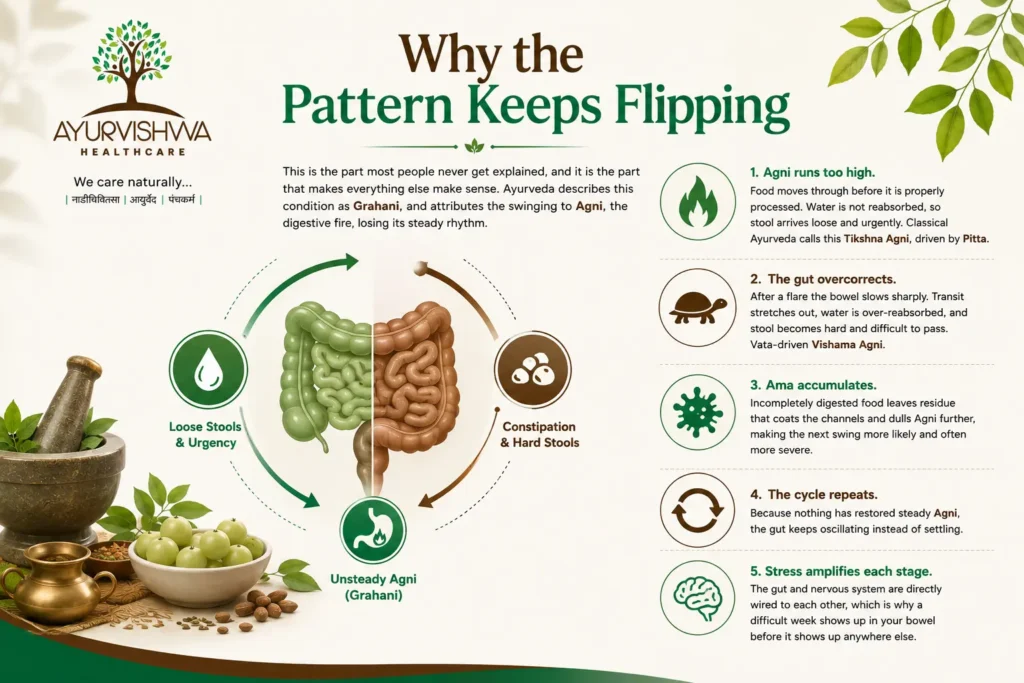
Why the Pattern Keeps Flipping
This is the part most people never get explained, and it is the part that makes everything else make sense. Ayurveda describes this condition as Grahani, and attributes the swinging to Agni, the digestive fire, losing its steady rhythm.
- Agni runs too high. Food moves through before it is properly processed. Water is not reabsorbed, so stool arrives loose and urgently. Classical Ayurveda calls this Tikshna Agni, driven by Pitta.
- The gut overcorrects. After a flare the bowel slows sharply. Transit stretches out, water is over-reabsorbed, and stool becomes hard and difficult to pass. Vata-driven Vishama Agni.
- Ama accumulates. Incompletely digested food leaves residue that coats the channels and dulls Agni further, making the next swing more likely and often more severe.
- The cycle repeats. Because nothing has restored steady Agni, the gut keeps oscillating instead of settling.
- Stress amplifies each stage. The gut and nervous system are directly wired to each other, which is why a difficult week shows up in your bowel before it shows up anywhere else.
This is also why treating a loose phase with a binding remedy, then treating constipation a week later with a laxative, tends to keep you on the same wheel. Each remedy addresses one end of the swing while leaving the instability untouched. The swing itself is the symptom, and it is what treatment has to target.
What Affects IBS Beyond the Gut Itself
Two people with the same diagnosis can have very different experiences. These are the factors a good Ayurvedic physician weighs alongside the bowel pattern, because several of them are modifiable before any medicine is prescribed.
- Meal timing. Skipped meals, late-night eating and irregular schedules disrupt Agni more than most people expect. In clinic, correcting timing alone settles a meaningful proportion of mild cases.
- Trigger foods. These vary by person, but excess caffeine, fried and heavily processed food, carbonated drinks, dairy and very spicy meals are the usual suspects. Raw and cold food is harder to digest during a flare.
- Stress and sleep. Poor sleep reliably predicts worse symptoms the next day, and stress is the most consistently reported flare trigger. Addressing food while ignoring these produces partial results at best.
- A past gut infection. Food poisoning or gastroenteritis can leave the gut sensitised for months, which changes how quickly treatment works and how it should be sequenced.
- Medication history. Repeated courses of antibiotics or regular painkiller use can disturb the gut environment and leave digestion unsettled long after the course ends.
- Coexisting conditions. Acidity and gastritis, thyroid imbalance and chronic stress and insomnia frequently travel alongside IBS and usually need addressing at the same time rather than afterwards.
Because these interact, no online article can tell you what is driving your case. Only a physician who has taken your history and read your pulse can give you an individual assessment, and that assessment is worth considerably more than any general guide.
How Long Ayurvedic Treatment Realistically Takes
Here is the honest part that marketing tends to skip. Ayurvedic care for IBS is not fast, and anyone promising results in a fortnight is selling you something rather than treating you.
Many people notice initial improvement within a few weeks of consistent diet and timing changes, often before herbs have had time to do much at all. The fuller plan, covering herbs, diet and stress management together, is generally followed for three to six months before results hold reliably. Chronic cases running many years, or cases complicated by a past gut infection or long-term medication use, can take longer.
Progress is also rarely linear. A good month can be followed by a flare triggered by travel, a stressful stretch at work or a single unwise meal, and that does not mean the treatment has failed. What matters is whether flares are becoming less frequent, less severe and shorter over a period of months. Setting this expectation at the start protects you from abandoning a plan that was actually working. If your symptoms have not shifted at all after a few months of genuine consistency, that is worth raising with your doctor rather than quietly continuing.

Why You Should Question a Guaranteed Cure Claim
Search for IBS treatment and you will find plenty of promises of a permanent cure. It is worth understanding why that language deserves scepticism rather than trust.
First, Ayurveda itself does not claim a cure for Grahani. Classical texts describe it as a condition requiring sustained correction of Agni and ongoing attention to diet and routine, not a course of medicine after which the matter is closed. A practitioner promising otherwise is departing from the tradition they are invoking.
Second, under the Drugs and Magic Remedies (Objectionable Advertisements) Act, advertising a cure for chronic conditions is not permitted in India. A clinic willing to breach that in its marketing is telling you something about how it will behave in its clinical claims too.
Third, IBS genuinely varies. Some people reach a point where flares are rare and mild. Others manage a long-term pattern that needs periodic attention. Both are legitimate outcomes, and a physician who acknowledges the second is being more useful to you than one who implies only the first exists. The more reliable signal of quality is not a bold promise. It is a doctor willing to give you a realistic timeline, to say plainly what Ayurveda can and cannot do for your case, and to refer you onward when something needs a specialist.
What to Ask at Your First Consultation
These questions turn a vague treatment plan into something you can actually follow and judge. The willingness to answer them tells you as much as the answers do.
- Which pattern do you think I have, and what led you to that conclusion?
- What is a realistic timeline for my case specifically, not IBS in general?
- What should I expect in the first month, and what would tell us this is not working?
- Are any of these herbs unsuitable alongside the medication I already take?
- What should I change in my diet and routine before the medicines even start?
- Are there any symptoms that should send me to a conventional doctor rather than back to you?
A trustworthy physician will welcome each of these and answer clearly. If the response is a confident promise with no detail, treat that as a reason to look more closely, not less.
When Digestive Symptoms Need a Doctor First
Most IBS is manageable and not dangerous. But some signs mean something other than IBS should be ruled out before any long-term plan begins, Ayurvedic or otherwise.
- Blood in the stool, or black tarry stools
- Unexplained weight loss
- Fever alongside digestive symptoms
- Symptoms that wake you from sleep
- A new change in bowel habit after age 50
- Difficulty swallowing or persistent vomiting
- A family history of bowel cancer, inflammatory bowel disease or coeliac disease
- Anaemia found on a blood test
None of these rule out also having IBS. They simply mean the sequence matters: evaluation first, then a long-term plan. Any good Ayurvedic physician will tell you the same, and will coordinate with your treating doctor rather than around them.
Our Approach to IBS at Ayurvishwa Healthcare
We do not advertise a cure or a fixed number of weeks, because IBS varies too much between people for either to be honest. Instead we focus on the things that genuinely support a good outcome and that you can judge for yourself.
- ✅ A personalised assessment through Nadi Pariksha and Prakriti Parikshan at your first visit, rather than a standard IBS protocol handed to everyone
- ✅ A realistic timeline given up front, including what should improve first and what would tell us the plan needs changing
- ✅ Care led by Dr. Vishwas Ghatge, BAMS · MD Ayurveda, practising root-cause Ayurvedic medicine for 18+ years
- ✅ Diet and daily routine treated as part of the prescription, not as an afterthought handed over on a printed sheet
- ✅ Honest scoping — we say plainly what Ayurveda can help with and what needs a conventional specialist first
- ✅ Online consultations across India, or in person at any of our 14 clinics across Maharashtra, with medicines dispensed from your nearest one
Call: +91 84484 49260 | WhatsApp: +91 91684 00980 | Email: info@ayurvishwahealthcare.com
Want a Realistic Assessment of Your Own Case?
Bring any reports you already have and get a personalised assessment through Nadi Pariksha, explained clearly with no promises attached. First appointment typically within 48 hours.
Related Digestive Health Guides
→ Bloating After Every Meal, Explained
📋 In This Article
- What IBS Actually Is
- Which Pattern Do You Have
- Why the Pattern Flips
- What Affects IBS
- Realistic Expectations
- Guaranteed Cure Claims
- What to Ask
- When to See a Doctor
- Our Approach
- FAQs
Get a realistic, personalised assessment. Call us or send a message.
IBS and Ayurveda, Frequently Asked Questions
An occasional upset stomach passes within a day or two and is usually tied to something specific, like a particular meal. IBS is a repeating pattern of abdominal pain and altered bowel habits lasting three months or more, typically with pain that eases after passing stool. The repetition is what distinguishes the two, not the severity of any single episode.
This mixed pattern happens when gut transit time is unstable rather than simply too fast or too slow. After a fast, loose phase the bowel often overcorrects and slows sharply, producing hard stool and straining. Ayurveda explains this as unsteady Vata dosha disturbing Agni, so food sometimes moves through before it is processed and sometimes sits too long. The swing itself is what treatment has to target.
Ayurveda refers to this pattern as Grahani, describing a weakened ability of the digestive site to properly hold and process food. It is understood mainly as a disturbance of Vata and Pitta dosha linked to irregular Agni, or digestive fire, with Ama, meaning incompletely digested residue, accumulating as a result and dulling Agni further.
Ayurveda does not claim a cure for IBS, and you should be cautious of anyone who does. Classical texts describe Grahani as a condition requiring sustained correction of Agni and ongoing attention to diet and routine. What Ayurvedic care aims to do is correct the root imbalance so flares become infrequent and mild. Many people reach that point; for others it remains a long-term pattern needing periodic attention. Both are legitimate outcomes.
Many people notice initial improvement within a few weeks of consistent diet and timing changes, often before herbs have had much effect. The fuller plan covering herbs, diet and stress management is generally followed for three to six months before results hold reliably. Chronic cases running many years may take longer. Progress is rarely linear, and a flare after a good month does not mean the plan has failed.
Meal timing is frequently the largest single lever, ahead of which specific foods you remove. Beyond that, the main factors are stress and sleep quality, trigger foods, any past gut infection, medication history including repeated antibiotics, and coexisting conditions such as acidity or thyroid imbalance. Because these interact, two people with the same diagnosis can have very different experiences and need different plans.
Yes. The gut and the nervous system are directly connected, and stress is one of the most consistently reported triggers for flares. This is why managing stress and sleep alongside diet is an essential part of a complete plan rather than an optional extra. Patients who address only the food side typically see partial and short-lived improvement.
Common triggers include excess caffeine, fried and heavily processed food, carbonated drinks and very spicy meals. Raw and cold food can also be harder to digest during a flare, as can curd at night. Triggers vary considerably between people, so tracking your own pattern for a couple of weeks alongside a doctor’s guidance is far more useful than following a generic avoid-list, and less likely to leave you with nutritional gaps.
Usually yes, and you should not stop prescribed medication on your own. Bring your current prescriptions and any recent reports to your consultation, because some herbs interact with certain conventional drugs and that is exactly why the full list matters. Dr. Ghatge is glad to coordinate with your treating physician rather than work around them.
See a doctor promptly if you notice blood in the stool, unexplained weight loss, fever alongside digestive symptoms, symptoms that wake you from sleep, or a new change in bowel habit after age 50. A family history of bowel cancer, inflammatory bowel disease or coeliac disease also warrants evaluation first. None of these rule out also having IBS, but they need investigating before any long-term plan begins.
Understand What Is Actually Driving Your Gut
A personalised assessment through Nadi Pariksha, a realistic timeline, and a plan built around your constitution. Online across India or at any of our 14 clinics. It starts with one call.