

Summary: A burning feeling every time you urinate, or a sharp pain that grips your back and doubles you over, both send people searching the same question, is this a UTI or a kidney stone. The two are treated very differently, so telling them apart matters. This guide explains how to recognise which one you are likely dealing with, what Ayurveda calls each condition, when either needs urgent medical care, and what doctor guided Ayurvedic support can realistically add.
We use general ranges and classical Ayurvedic terms rather than promises, because an accurate picture of what is happening is more useful to you than any clinic claiming a guaranteed fix.
Written and medically reviewed by Dr. Vishwas Ghatge, BAMS, MD (Ayurveda), Founder of Ayurvishwa Healthcare, practising Nadi Pariksha guided Ayurvedic medicine for 18+ years. This content is for general wellness awareness and is not intended to diagnose, treat, cure or prevent any disease.
UTI vs Kidney Stone, at a Glance
Type of pain
UTI: a constant burning or pressure, most noticeable while urinating. Kidney stone: sharp, wave like pain that comes and goes as the stone moves.
Where you feel it
UTI: lower abdomen and pelvis. Kidney stone: back or side, often radiating toward the groin as the stone travels.
Urination pattern
UTI: frequent urge, small amounts each time, cloudy or strong smelling urine. Kidney stone: blood in the urine is common, frequency depends on where the stone sits.
Other signs
UTI: fever can mean the infection has reached the kidneys. Kidney stone: nausea and vomiting are common when pain is severe.
These are general patterns, not a diagnosis. The two conditions can also occur together, and a urine test or scan is the only reliable way to confirm which you are dealing with.
Burning Pain or Sharp Pain, What Your Body Is Telling You
A urinary tract infection happens when bacteria enter the urinary tract, most often through the urethra, and multiply, irritating the bladder lining. This is what produces the constant burning sensation and the urge to urinate that so many people describe. Roughly six in ten women and about one in eight men will have at least one UTI in their lifetime.
A kidney stone is a different mechanism entirely. Minerals and salts in concentrated urine crystallise into a hard deposit inside the kidney. Small stones can pass unnoticed. Larger ones cause sharp, colicky pain as they move into the ureter, the narrow tube carrying urine to the bladder, and try to squeeze through. Around two to three percent of people will experience a kidney stone at some point, and once you have had one, the chance of another is meaningfully higher.
To see how we approach both conditions clinically, read about our Ayurvedic approach to urinary disorders.
Symptoms That Point One Way or the Other
- UTI: burning during urination, a frequent and urgent need to go, passing only small amounts each time, cloudy or strong smelling urine, mild pelvic pressure
- Kidney stone: sudden, severe pain in the back or side that comes in waves, pain that spreads toward the lower abdomen or groin, blood in the urine, nausea and vomiting when pain is intense
- Shared signs: both can cause blood in the urine and an increased urge to urinate, which is exactly why the two get confused
A useful rule of thumb, a burning, constant discomfort that gets worse while urinating usually points to a UTI. A sharp, wave like pain that grips your back or side and comes and goes usually points to a stone. When in doubt, a urine test and, if needed, a scan will settle it quickly.
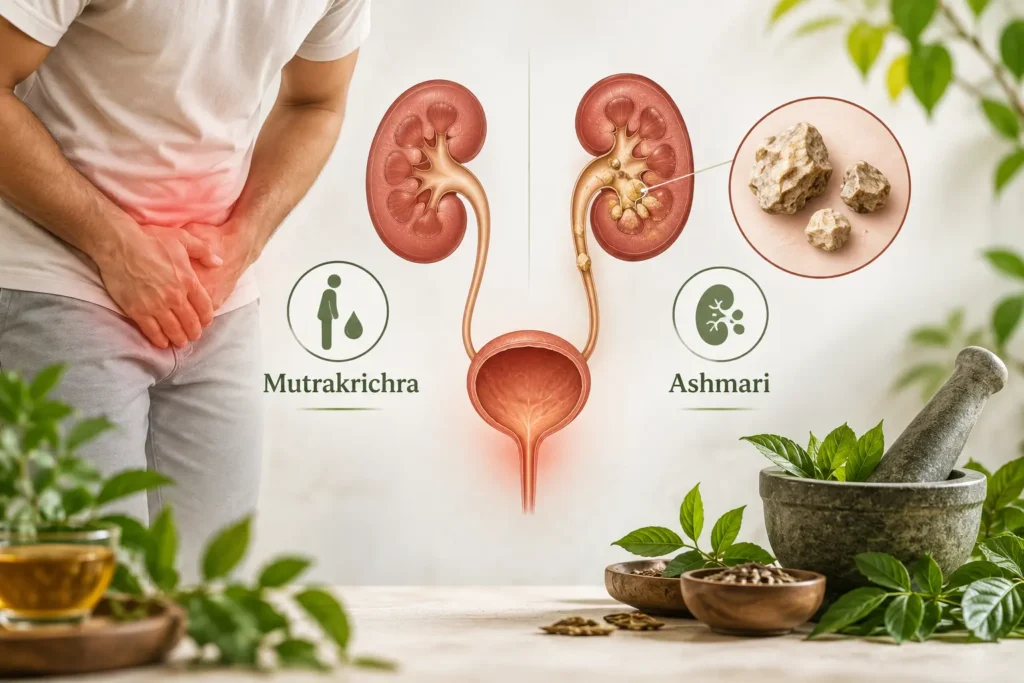
The Ayurvedic View: Mutrakrichra and Ashmari
Ayurveda calls painful, difficult urination Mutrakrichra, generally linked to aggravated Pitta and Vata irritating the urinary channels, along with an accumulation of Ama that inflames the tract, mirroring what conventional medicine identifies as a bacterial infection.
Kidney stones are called Ashmari, or Mutrashmari, and are classically considered Tridoshaja, meaning all three doshas can contribute, though a Vata Kapha pattern with obstruction, or Sanga, in the urinary channels is central. Classical texts describe different stone types by dosha, Vataja stones tending to be rough and associated with severe pain, Pittaja stones linked to a burning quality, and Kaphaja stones larger, smoother and associated with heaviness. Which pattern applies affects the herbs and approach used.
When Either Condition Needs Urgent Medical Attention
Both conditions are usually manageable, but a few signs mean you need same day medical care rather than a wellness routine.
- Fever or chills alongside burning urination or back pain, which can mean a UTI has spread to the kidneys
- Severe pain you cannot manage, or vomiting that will not let you keep fluids down
- Complete inability to urinate
- Heavy blood in the urine, or blood with clots
- Pain during pregnancy, or a UTI in a man, both of which warrant prompt evaluation rather than a wait and see approach
A UTI that has reached the kidneys, or a stone that is completely blocking urine flow while infected, are genuine emergencies that need antibiotics or a procedure, not herbal support alone. Ayurvedic care has a real role in both conditions, but always after these possibilities have been ruled out or are being actively treated.
Not Sure Which One You Are Dealing With?
Get a personalised assessment through Nadi Pariksha, explained clearly with no promises attached.
How Ayurveda Helps With UTI and Kidney Stones
1. Cooling and Anti Inflammatory Support for UTI
Herbs traditionally used to pacify Pitta and soothe the urinary lining are used alongside, not instead of, antibiotics when an active infection is present.
2. Mutrala and Ashmarighna Herbs for Stones
Classical diuretic herbs, called Mutrala, along with stone targeting herbs traditionally referred to as Ashmarighna, such as Gokshura, Punarnava and Pashanbheda, are used to support the passage of small stones and reduce recurrence.
3. Apana Vayu Anulomana
Correcting the downward movement of Apana Vayu, the Vata subtype governing the pelvis and urinary tract, is considered central to easing obstruction and pain.
4. Basti and Uttar Basti for Chronic Cases
For recurring UTIs or a pattern of repeated stone formation, Basti and Uttar Basti, specialised enema therapies aimed at cleansing and toning the urinary tract, are sometimes used under close clinical supervision.
This information is for general wellness awareness only and is not intended to diagnose, treat, cure or prevent any disease. A UTI with fever, or a stone causing severe pain, needs prompt medical evaluation, and Ayurvedic support works alongside that care, not as a substitute for it.
Support Urinary Health With Mutra Dosh Har Vati
Ayurvishwa’s Mutra Dosh Har Vati is formulated to support healthy urinary function and comfort as part of an overall care plan. It is not a substitute for antibiotics during an active infection or for medical management of a stone causing severe pain, and works best alongside a personalised assessment.
Explore Uriclean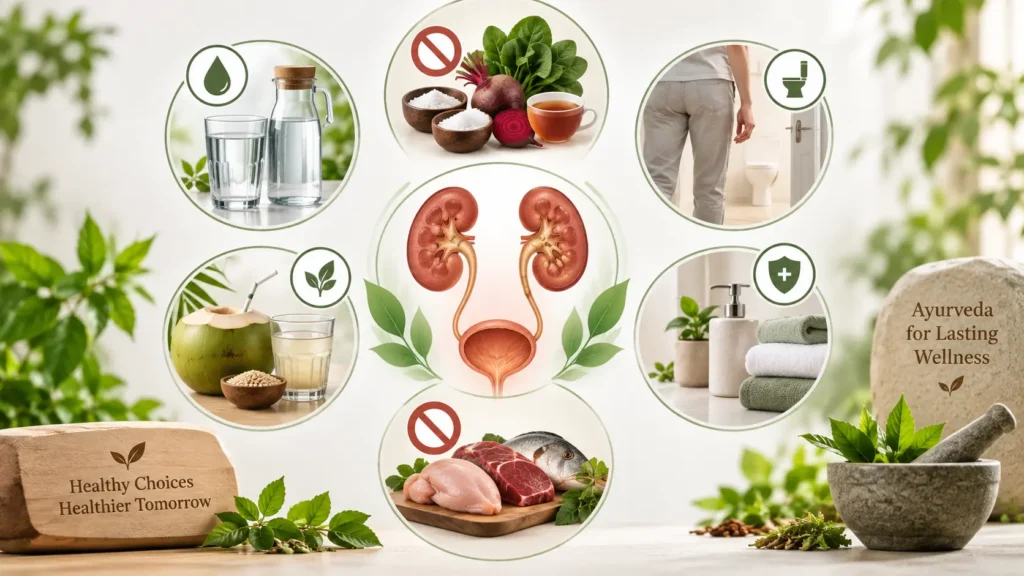
Diet and Lifestyle for Urinary Health
- Drink two and a half to three litres of water a day, the single most consistent recommendation for both conditions
- Reduce excess salt, sugar and oxalate rich foods such as spinach, beetroot and excess tea if you are prone to stones
- Urinate when you feel the urge rather than holding it for long periods
- Coconut water and barley water are traditionally used as cooling, mildly diuretic drinks
- Maintain good hygiene practices, particularly for women prone to recurring UTIs
- Avoid excess animal protein if you have a history of stones, since it raises uric acid and calcium in the urine
How Long This Realistically Takes
An active UTI, once antibiotics have started if needed, typically settles within a few days to a week, with Ayurvedic support helping with comfort and reducing recurrence over the following months. Small kidney stones can pass within days to a few weeks with adequate hydration and support. Larger stones, generally above six to seven millimetres, often will not pass on their own and need a urologist’s input regardless of any herbal support used alongside. Preventing new stones from forming is a longer project, generally assessed over six months to a year through diet, hydration habits and periodic monitoring.
Why You Should Question a Guaranteed Cure Claim
Search for kidney stone treatment and you will find plenty of promises to dissolve any stone naturally within days. Be sceptical of this, particularly for larger stones, since size is the main factor in whether a stone can pass on its own at all, and no herb changes that physics.
Ayurveda has a genuine, well documented role in supporting smaller stones, easing symptoms and reducing recurrence, but it does not replace a urologist’s assessment for a stone that is large, causing severe obstruction, or infected. Under the Drugs and Magic Remedies (Objectionable Advertisements) Act, advertising a guaranteed cure for such conditions is not permitted in India, and a clinic willing to overstate this in marketing is telling you something about how it may handle your care too. A physician who tells you plainly when a stone needs a urologist, rather than promising herbs will handle everything, is being more useful to you than one who does not.
What to Ask at Your First Consultation
- Based on my symptoms, do you think this is a UTI, a stone, or possibly both?
- Do I need a urine test or a scan before starting any treatment?
- If it is a stone, what size is it, and does that change the plan?
- Should I be seeing a urologist alongside Ayurvedic care?
- What would tell us this plan is not working and needs to change?
A trustworthy physician will welcome each of these and answer clearly, including telling you plainly when a scan or a urologist is needed.
Our Approach to Urinary Health at Ayurvishwa
- A personalised assessment through Nadi Pariksha and Prakriti Parikshan, rather than a standard protocol handed to every patient
- Honest scoping about whether a case needs a urologist alongside, or instead of, Ayurvedic care
- Diet and hydration habits treated as part of the prescription, particularly important for preventing recurrence
- Care led by Dr. Vishwas Ghatge, BAMS, MD (Ayurveda), with 18+ years of clinical experience, across 15+ clinics in Maharashtra
Call +91 8448449260, WhatsApp +91 91684 00980, or email ayurvishwahealthcare@gmail.com to book your consultation.
Related Guides
📋 In This Article
- What Is Happening
- Symptoms
- The Ayurvedic View
- When to Get Urgent Care
- How Ayurveda Helps
- Recommended Support
- Diet and Lifestyle
- Realistic Timeline
- Guaranteed Cure Claims
- What to Ask
- Our Approach
- FAQs
Get a personalised assessment.
UTI vs Kidney Stone, Frequently Asked Questions
A constant burning discomfort that is worse while urinating usually points to a UTI. A sharp, wave like pain gripping your back or side, coming and going, usually points to a kidney stone. Both can cause blood in the urine, which is why a urine test or scan is the only reliable way to confirm which you have.
Smaller stones can sometimes pass with the support of hydration, diuretic herbs and dietary changes. Larger stones, generally above six to seven millimetres, often will not pass on their own regardless of treatment approach and need a urologist’s assessment. Ayurveda supports the process for smaller stones rather than guaranteeing to dissolve any stone.
Ayurveda refers to painful, difficult urination as Mutrakrichra, linked to aggravated Pitta and Vata with Ama accumulation in the urinary tract. Kidney stones are called Ashmari or Mutrashmari, classified as Tridoshaja with a central Vata Kapha pattern and obstruction in the urinary channels.
For an active bacterial infection, particularly with fever or back pain suggesting it has reached the kidneys, antibiotics are usually necessary and should not be delayed in favour of herbal support alone. Ayurvedic care works well alongside antibiotics for comfort and to reduce recurrence, rather than as a replacement during an active infection.
Seek urgent care for severe pain you cannot manage, vomiting that will not let you keep fluids down, complete inability to urinate, heavy bleeding, or fever alongside back pain, which can signal an infected, obstructed kidney. These need same day medical evaluation, not home or herbal treatment alone.
Reducing excess salt, sugar and oxalate rich foods such as spinach and beetroot helps for many stone types, alongside limiting excess animal protein. The right dietary changes depend on your specific stone type, which is best assessed by your doctor rather than following a generic avoid list.
Diuretic and Pitta pacifying herbs, along with hydration and hygiene habits, are traditionally used to support urinary tract health and may help reduce how often UTIs recur. This works best as part of a personalised plan rather than a generic herbal routine.
Small stones can pass within days to a few weeks with adequate hydration and support. Preventing new stones from forming is a longer project, generally assessed over six months to a year through diet, hydration habits and periodic monitoring.
Yes. A stone can sometimes lead to a urinary tract infection, since it obstructs normal urine flow and creates conditions bacteria can thrive in. This combination needs prompt medical evaluation, since an infected, obstructed kidney is a genuine emergency.
See a doctor promptly for fever, severe or worsening pain, inability to urinate, heavy blood in the urine, or if you are pregnant or male, since UTIs in these situations need direct medical evaluation rather than a wait and see approach.
Get a Clear Answer, Not a Guess
A personalised assessment through Nadi Pariksha, a realistic timeline, and honest guidance on whether you need a urologist alongside your care.