

Summary: The rain has stopped, but your nose has not gotten the message. A blocked nose, a heavy feeling behind the eyes and forehead, and a headache that will not fully lift are common in the weeks right after the monsoon, and they are often written off as a lingering cold. This guide explains how to tell sinusitis apart from a cold, why it spikes after the rains, what Ayurveda calls this pattern, and what doctor guided treatment realistically involves.
We use general ranges and classical Ayurvedic terms rather than promises, because an honest picture of what is happening is more useful to you than any clinic claiming a guaranteed fix for a condition that tends to recur.
Written and medically reviewed by Dr. Vishwas Ghatge, BAMS, MD (Ayurveda), Founder of Ayurvishwa Healthcare, practising Nadi Pariksha guided Ayurvedic medicine for 18+ years. This content is for general wellness awareness and is not intended to diagnose, treat, cure or prevent any disease.
Cold, Allergy or Sinusitis, at a Glance
Common cold
Symptoms peak within two to three days, discharge is thin and clear, and it usually resolves within a week to ten days on its own.
Allergic rhinitis
Frequent sneezing, itchy eyes or nose, and clear watery discharge, often tied to a specific trigger and without facial pain.
Sinusitis
Thick yellow or green discharge, facial pain or pressure that worsens on bending forward, a heavy feeling in the head, and symptoms lasting beyond ten days or worsening after initially improving.
Ayurvedic name
Pinasa for the acute form, Dushta Pratishyaya for the chronic, recurring form.
These are general patterns, not a diagnosis. Overlap is common, and a proper assessment is the only reliable way to know which applies to you.
What Is Sinusitis, and Why It Spikes After the Rains
Your sinuses are air filled spaces behind your forehead, cheeks and eyes, lined with a thin layer of mucus that traps dust and germs before draining away through the nose. Sinusitis happens when that drainage gets blocked, mucus builds up, and the lining becomes inflamed, sometimes alongside an infection.
The weeks after the monsoon are a well known trigger period. Prolonged damp, humid conditions, sudden temperature swings between rain showers and clear spells, and higher pollen and mould exposure as things dry out all add up. Add in a body that has spent weeks in monsoon mode, and the sinuses are primed to react the moment conditions shift again.
Symptoms That Point to Sinusitis, Not Just a Cold
- Thick yellow or green nasal discharge, rather than thin and clear
- Facial pain or pressure around the forehead, cheeks or behind the eyes, often worse when bending forward
- A heavy, dull headache that does not fully lift, sometimes worse at night
- Reduced sense of smell or taste
- Post nasal drip, a persistent cough, or bad breath that was not there before
- Symptoms lasting beyond ten days, or improving briefly before getting worse again
That last pattern, feeling better and then worse again, is one of the more reliable signs that a simple cold has turned into something that needs proper attention.
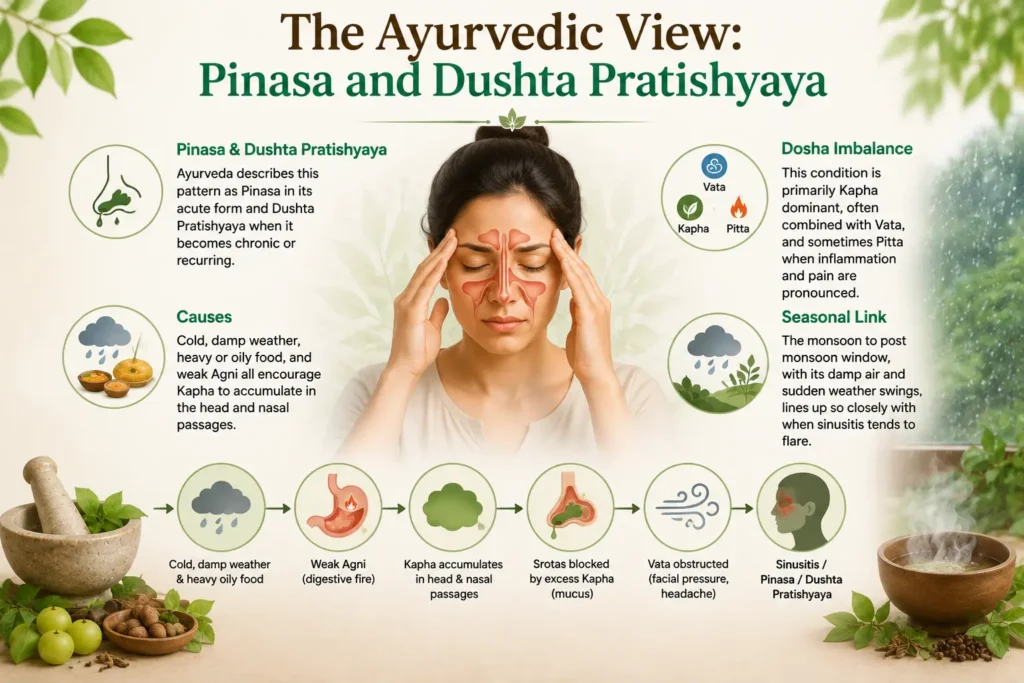
The Ayurvedic View: Pinasa and Dushta Pratishyaya
Ayurveda describes this pattern as Pinasa in its acute form and Dushta Pratishyaya, meaning vitiated rhinitis, when it becomes chronic or recurring. It is understood as a Kapha dominant imbalance, often combined with Vata, and sometimes Pitta when inflammation and pain are pronounced.
Cold, damp weather, heavy or oily food, and weak Agni all encourage Kapha to accumulate in the head and nasal passages. Once accumulated, this excess Kapha blocks the srotas, the body’s channels, trapping mucus and obstructing the movement of Vata, which is believed to be behind the facial pressure and headache that come with it. This is also why the monsoon to post monsoon window, with its damp air and sudden weather swings, lines up so closely with when sinusitis tends to flare.
When Sinus Symptoms Need Urgent Medical Attention
Most sinusitis is uncomfortable but not dangerous. A small number of cases need urgent care rather than home treatment.
- Swelling, redness or pain around one eye, or any change in vision
- A severe headache along with neck stiffness or confusion
- High fever alongside facial pain that persists for several days
- Symptoms that improve and then suddenly worsen again, with new or higher fever
These can signal that an infection is spreading beyond the sinuses, which is rare but needs immediate medical evaluation rather than any home or Ayurvedic remedy. For everything else, this is a condition well suited to steady, doctor guided management.
Not Sure If It Is a Cold or Something More?
Get a personalised assessment through Nadi Pariksha, explained clearly with no promises attached.
How Ayurveda Helps Clear Sinus Congestion
1. Nasya
Nasya, the administration of medicated oil through the nostrils, is considered one of the primary Ayurvedic therapies for sinus conditions, since the nose is treated as a direct route to the head. It is traditionally used to loosen accumulated mucus and support drainage.
2. Jala Neti
Saline nasal irrigation using a neti pot is a widely used practice to physically clear the nasal passages and reduce the mucus load the sinuses are dealing with.
3. Swedana
Steam inhalation, sometimes with added herbs, is traditionally used to loosen thick mucus and ease facial pressure.
4. Classical Herbal Support
Herbs such as Tulsi, Pippali and Trikatu are traditionally used to support respiratory clearance and Agni, chosen based on your specific pattern rather than applied generically.
5. Panchakarma for Chronic or Recurring Cases
For longstanding Dushta Pratishyaya, a broader Panchakarma protocol is sometimes recommended to address the underlying Kapha imbalance more thoroughly, under clinical supervision.
This information is for general wellness awareness only and is not intended to diagnose, treat, cure or prevent any disease. Please consult a qualified Ayurvedic doctor before starting Nasya or any herbal formulation, and see a physician promptly if a bacterial infection is suspected, since this may need antibiotics.
Diet and Lifestyle to Support Recovery
- Warm, freshly cooked, easily digestible food such as soups and light khichdi, rather than cold or heavy meals
- Reduced dairy and curd in the evening, since these are traditionally considered to increase mucus
- Warming spices such as ginger, black pepper and cumin, which support both Agni and clear breathing
- Staying warm and avoiding direct exposure to cold wind or the first splash of unexpectedly cold weather
- Elevating your head slightly while sleeping, which can ease overnight congestion and pressure
- Avoiding daytime napping and very cold drinks, both of which are traditionally linked to increased Kapha
If a cough is lingering alongside the congestion, our page on Ayurvedic care for cough and cold covers that side of recovery in more depth.
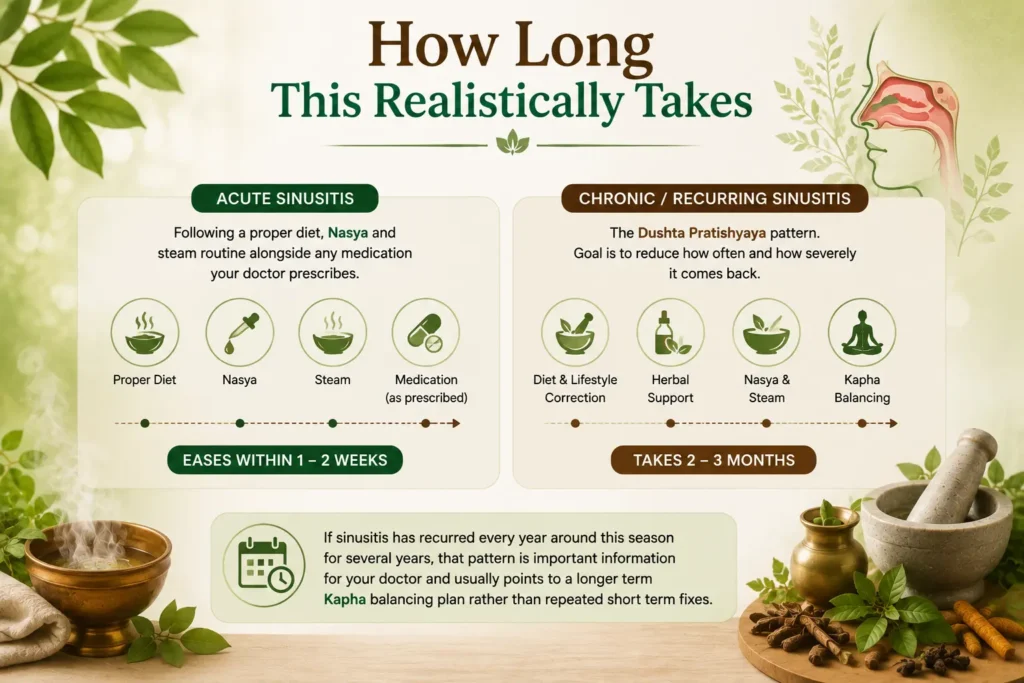
How Long This Realistically Takes
Acute sinusitis, following a proper diet, Nasya and steam routine alongside any medication your doctor prescribes, often eases within one to two weeks. Chronic or recurring sinusitis, the Dushta Pratishyaya pattern, is a different picture, since the goal shifts from clearing a single episode to reducing how often and how severely it comes back, which generally takes a fuller plan followed over two to three months.
If sinusitis has recurred every year around this season for several years, that pattern itself is useful information for your doctor, and usually points toward a longer term Kapha balancing plan rather than repeated short term fixes.
Why You Should Question a Guaranteed Cure Claim
Search for sinusitis treatment and you will find plenty of promises to cure it permanently in days. For a condition that tends to recur with the seasons, particularly the chronic pattern, cure is not really the honest word, and a physician who uses it that loosely is worth a second look.
What doctor guided Ayurvedic care can realistically offer is a reduction in how often sinusitis flares and how severe each episode is, alongside faster relief during an active flare. Under the Drugs and Magic Remedies (Objectionable Advertisements) Act, advertising a guaranteed cure for a recurring condition is not permitted in India, and a clinic willing to overstate this in marketing is telling you something about how it may handle your care too. A physician who gives you a realistic picture of what to expect, including the possibility of recurrence, is being more useful to you than one who promises it will never come back.
What to Ask at Your First Consultation
- Does my pattern look acute, or is this a recurring, chronic pattern?
- Is there any sign this could be bacterial, and would I need antibiotics alongside Ayurvedic care?
- What is a realistic timeline for this specific episode?
- What should I change about my routine each year before this season arrives again?
- What would tell us this plan is not working and needs to change?
A trustworthy physician will welcome each of these and answer clearly, including being upfront about when antibiotics are the right call.
Our Approach to Sinusitis at Ayurvishwa
- A personalised assessment through Nadi Pariksha and Prakriti Parikshan, rather than a standard protocol handed to every patient
- Honest scoping about whether your case looks acute or chronic, and whether antibiotics may be needed alongside Ayurvedic care
- Diet and seasonal routine treated as part of the prescription, particularly useful for a condition that tends to recur with the weather
- Nasya and other therapies performed under proper clinical guidance, not left to guesswork at home
- Care led by Dr. Vishwas Ghatge, BAMS, MD (Ayurveda), with 18+ years of clinical experience, across 15+ clinics in Maharashtra
📋 In This Article
- What Is Happening
- Symptoms to Watch
- The Ayurvedic View
- When to Get Urgent Care
- How Ayurveda Helps
- Diet and Lifestyle
- Realistic Timeline
- Guaranteed Cure Claims
- What to Ask
- Our Approach
- FAQs
Get a personalised assessment.
Post Monsoon Sinusitis, Frequently Asked Questions
A cold usually peaks within two to three days with thin, clear discharge and clears up within a week to ten days. Sinusitis tends to bring thick yellow or green discharge, facial pain or pressure that worsens on bending forward, and symptoms that last beyond ten days or improve then suddenly worsen again.
Prolonged damp conditions, sudden temperature swings between rain and clear spells, and rising pollen and mould as things dry out all encourage Kapha accumulation in the head, according to Ayurveda, which lines up closely with why this period is a well known trigger window.
Ayurveda refers to acute sinusitis as Pinasa and the chronic, recurring form as Dushta Pratishyaya, meaning vitiated rhinitis. It is understood as a Kapha dominant imbalance, often combined with Vata, arising when excess Kapha blocks the body’s channels in the head and nasal passages.
For a condition that tends to recur with the seasons, cure is not really the accurate word. Doctor guided Ayurvedic care aims to reduce how often sinusitis flares and how severe each episode is, alongside faster relief during an active flare, rather than promising it will never return.
Nasya is the Ayurvedic administration of medicated oil through the nostrils, considered one of the primary therapies for sinus conditions since the nose is treated as a direct route to the head. It is traditionally used to loosen accumulated mucus and support drainage, and should be done under proper guidance.
Symptoms lasting beyond ten days without improvement, or improving briefly before suddenly worsening again with new or higher fever, are patterns that often point toward a bacterial infection needing antibiotics. This should be assessed by a doctor rather than decided at home.
Generally yes, for straightforward congestion, using clean or properly prepared saline solution and standard precautions. If symptoms are severe, worsening, or you are unsure how to do these safely, it is worth checking with a doctor first, particularly before starting Nasya with medicated oils.
Dairy and curd in the evening, cold food and drinks, and heavy, oily meals are generally best limited, since Ayurveda considers these likely to increase Kapha and mucus. Warm, freshly cooked, easily digestible food is usually easier on the body during a flare.
An acute episode, with proper diet and therapy alongside any medication needed, often eases within one to two weeks. Chronic or recurring sinusitis is managed over a longer plan, generally two to three months, aimed at reducing frequency and severity rather than a single quick fix.
Seek urgent care if you notice swelling, redness or pain around one eye, any change in vision, a severe headache with neck stiffness or confusion, or high fever alongside facial pain that persists for several days. These can signal a rare but serious spread of infection beyond the sinuses.
Get to the Bottom of the Congestion
A personalised assessment through Nadi Pariksha, a realistic timeline, and honest guidance on whether this needs more than home care.