

Summary: The clouds thin out, the sun sharpens, and the humid heaviness of monsoon gives way to clear autumn skies. Ayurveda has watched this exact handover for thousands of years and has a name for what happens inside the body during it, Sharad Ritu, the season when accumulated Pitta gets provoked. This guide explains why the season change itself is a health risk, what Pitta aggravation actually looks like, and how to prepare your diet, routine and body before it catches up with you.
This is preventive, seasonal guidance rooted in classical Ayurvedic texts, not a treatment plan for an existing condition. If you already have a diagnosed condition, read this alongside, not instead of, your doctor’s advice.
Written and medically reviewed by Dr. Vishwas Ghatge, BAMS, MD (Ayurveda), Founder of Ayurvishwa Healthcare, practising Nadi Pariksha guided Ayurvedic medicine for 18+ years. This content is for general wellness awareness and is not intended to diagnose, treat, cure or prevent any disease.
From Monsoon to Autumn: What Changes
Dosha shift
Varsha (monsoon): Vata accumulates and gets aggravated. Sharad (autumn): Vata settles, while Pitta, quietly built up through the humid months, becomes aggravated by the sharper sun.
Common complaints
Varsha: joint stiffness, bloating, low digestive strength. Sharad: skin flare ups, acidity and heartburn, irritability, burning sensations, occasional low grade fever.
Ideal diet direction
Varsha: warm, light, easily digestible food with mild sour and salty notes. Sharad: sweet, bitter and astringent tastes, cooling and light rather than warming.
Classically favoured therapy
Varsha: Basti, a medicated enema therapy. Sharad: Virechana, a supervised purification therapy aimed at clearing aggravated Pitta.
Roughly, Varsha Ritu runs mid July to mid September, and Sharad Ritu runs mid September to mid November. The exact dates shift slightly each year with the lunar calendar, and the two week window where one season hands over to the next matters more than the calendar date itself, which is the focus of the next section.
Why the Season Change Itself Is a Health Risk
Ayurveda has a specific term for the handover between two seasons, Ritusandhi, the seasonal junction. It covers roughly the last week of the ending season and the first week of the new one, a two week window when the body is asked to adjust to genuinely different conditions in a short span of time.
Classical texts treat this junction as more sensitive than the seasons on either side of it, and recommend a gradual shift in diet and routine rather than an abrupt one. The reasoning holds up well in plain terms too, a body that has spent weeks adapting to humidity, cloud cover and moderate temperatures is not built to handle a sudden run of sharp sun and dry heat without some friction. That friction is exactly what shows up as the seasonal complaints so many people notice every year around this time, and largely dismiss as coincidence.
Why Autumn Is Called Pitta Season
Ayurveda describes a two stage process behind most seasonal complaints, accumulation in one season, followed by aggravation in the next. Through the monsoon, Pitta, the dosha governing heat and transformation in the body, quietly accumulates, encouraged by the humid, overcast conditions. It does not cause trouble yet, since the cooler, cloud covered weather keeps it in check.
Autumn removes that check. As the clouds clear and the sun sharpens, that accumulated Pitta gets provoked, a transition classical texts describe directly, Charaka Samhita states plainly that Pitta becomes aggravated in Sharad Ritu, and recommends a Pitta pacifying regimen in response. This is the entire logic behind calling autumn Pitta season, not that Pitta appears from nowhere, but that a slow buildup meets a sudden trigger.
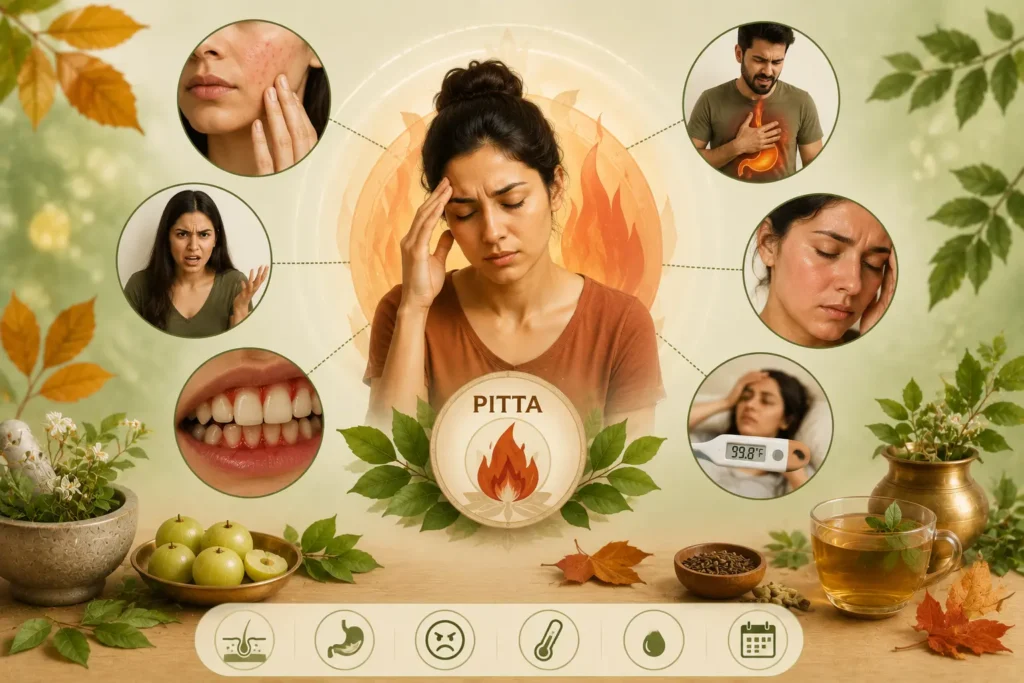
Signs Your Pitta Is Already Aggravated This Season
When Pitta becomes aggravated, Ayurveda holds that it affects Rakta, the blood tissue, before other tissues, which explains why the classical autumn complaints cluster so heavily around skin and blood related symptoms.
- Skin flare ups, including rashes, hives, boils or an eczema flare that seems to have appeared out of nowhere
- Acidity, heartburn or a burning sensation after meals that was not there in the monsoon months
- Increased irritability, impatience or a short temper that feels out of character
- A general sense of excess body heat, flushed skin or burning sensations in the eyes or soles of the feet
- A tendency toward minor bleeding, such as bleeding gums or nosebleeds
- Sharada Jwara, a low grade seasonal fever classical texts specifically associate with this time of year
None of these are guaranteed to happen, and most people notice only one or two, if any. But if several of these sound familiar right now, it is a reasonable sign that your Pitta pacifying routine should start sooner rather than later.
When to See a Doctor Rather Than Just Adjust Your Routine
Seasonal Pitta aggravation is common and generally manageable through diet and lifestyle. But a few signs deserve medical attention rather than a home routine.
- Fever that persists beyond two to three days, or is high grade rather than low grade
- Skin reactions that are spreading rapidly, blistering or accompanied by swelling of the face or throat
- Bleeding that is more than occasional and minor, or blood in vomit or stool
- Severe or persistent abdominal pain alongside acidity symptoms
These need proper evaluation first. Seasonal routine adjustments support general wellness, they are not a substitute for medical care when something more significant is going on.
Not Sure What Your Current Dosha Balance Looks Like?
Get a personalised assessment through Nadi Pariksha before the season fully turns.
Diet for Sharad Ritu: What to Favour and What to Limit
Favour
- Sweet, bitter and astringent tastes, which classically pacify Pitta
- Light, cooling and easily digestible food, including rice, moong dal, wheat, amla and seasonal gourds such as pumpkin, ash gourd and bottle gourd
- Cool, not iced, water, ideally boiled and then cooled, sipped through the day
- Sweet fruits such as pomegranate, grapes and ripe banana
- Ghee in moderate quantity, used for its cooling and nourishing qualities
Limit
- Sour foods, including excess curd, tamarind and fermented items
- Pungent, spicy and heavily fried food
- Excess salt, and foods that are very hot in temperature
- Overeating in general, since a heavy load on digestion adds to Pitta aggravation
If acidity or heartburn is your main seasonal complaint, our page on Ayurvedic care for gastritis and acidity covers this in more depth.
Lifestyle Adjustments for the Season Change
- Limit direct midday sun exposure, since strong sunlight is exactly what provokes accumulated Pitta
- Avoid daytime napping, which classical texts specifically flag for this season
- Spend a little time in the evenings under moonlight where possible, traditionally considered cooling and calming for Pitta
- Apply sandalwood paste or a similarly cooling application if skin heat or irritation is bothering you
- Keep meals unhurried and avoid eating to the point of heaviness, which adds directly to Pitta load
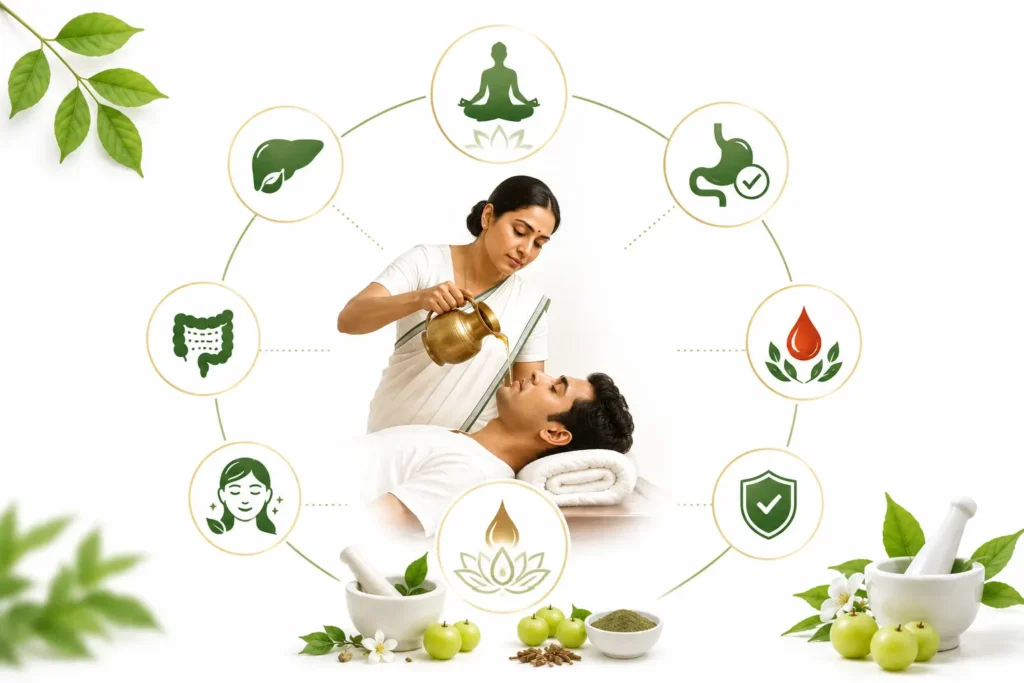
Why Virechana Is the Classically Recommended Therapy This Season
Of the classical Panchakarma therapies, Virechana, a supervised, medicated purgation therapy, is specifically recommended for Sharad Ritu, aimed at clearing aggravated Pitta from the body rather than letting it settle deeper. Some texts also mention Raktamokshana, a bloodletting therapy, for cases with pronounced excess Pitta.
Neither of these is a home remedy, and neither is necessary for everyone. Whether Virechana is appropriate for you depends on your current dosha balance, your Prakriti and your general health, which is exactly the kind of assessment a Panchakarma therapy needs before it begins, not something to attempt independently.
How Nadi Pariksha Helps You Personalise This Transition
Everything in this guide describes the general pattern for Sharad Ritu, but your actual Prakriti and your current dosha state decide how much of it applies to you specifically. Someone who is naturally Pitta dominant will usually feel this season’s effects earlier and more strongly than someone who is Kapha dominant.
Nadi Pariksha, our pulse based diagnostic method, reads your current dosha balance directly, rather than relying on a generic seasonal checklist. To understand how this fits into the wider system of Vata, Pitta and Kapha, our guide on Vata, Pitta, Kapha and Nadi Pariksha is a useful companion read, and our Nadi Pariksha resource guide explains what the assessment can and cannot reveal in more detail.
Book a Nadi Pariksha AssessmentCommon Mistakes During the Season Change
1. Switching Routines Overnight
Abruptly overhauling diet and lifestyle the day the calendar says autumn begins ignores the Ritusandhi principle. A gradual shift over the transition window works better than a sudden one.
2. Continuing Monsoon Habits Out of Convenience
Sour pickles, fried snacks and warming spices that suited the damp monsoon months become less suitable as Pitta rises, even if they still taste appealing.
3. Treating Every Symptom as a Standalone Problem
Skin flare ups, acidity and irritability appearing together in the same few weeks are often one seasonal pattern, not three unrelated issues, and are best addressed as such.
4. Attempting Panchakarma Therapies Without Guidance
Virechana and Raktamokshana are supervised clinical therapies, not something to replicate at home based on a general description. Attempting a version of these without proper assessment can do more harm than good.
📋 In This Article
- Why the Change Matters
- Why It Is Pitta Season
- Signs of Aggravation
- When to See a Doctor
- Diet Guidance
- Lifestyle Guidance
- Panchakarma and Virechana
- Personalising It
- Common Mistakes
- FAQs
Get a seasonal dosha assessment.
Monsoon to Autumn Season Change, Frequently Asked Questions
Ritusandhi is the seasonal junction, roughly the last week of one season and the first week of the next. Ayurveda considers this two week window especially sensitive, since the body is adjusting to genuinely different conditions in a short time, and recommends a gradual shift in diet and routine rather than a sudden one.
Pitta accumulates quietly through the humid, cloud covered monsoon months without causing trouble. When autumn’s clearer skies and sharper sun arrive, that accumulated Pitta gets provoked, which is why classical texts describe Sharad Ritu as the season when Pitta becomes aggravated.
Common signs include skin flare ups such as rashes or hives, acidity or a burning sensation after meals, increased irritability, a general sense of excess body heat, minor bleeding tendencies such as bleeding gums, and occasionally a low grade seasonal fever classical texts call Sharada Jwara.
Sour, pungent, fried and very hot foods, along with excess salt and curd, are generally best limited during this season, since they tend to add to Pitta aggravation. Sweet, bitter and astringent tastes in light, cooling food are favoured instead.
No. Virechana is a supervised purification therapy classically recommended for clearing aggravated Pitta, but whether it is appropriate depends on your individual dosha balance and health, assessed by a qualified doctor. It is not something to attempt without guidance, and not everyone needs it every season.
Yes. Nadi Pariksha reads your current dosha balance through your pulse, giving a more individual picture than a general seasonal checklist. This helps determine whether, and how strongly, this season’s Pitta pattern is affecting you specifically.
Sharada Jwara refers to a low grade seasonal fever that classical Ayurvedic texts specifically associate with the autumn transition, linked to aggravated Pitta. Persistent or high grade fever should always be evaluated by a doctor rather than assumed to be this.
Monsoon diet favours warm, light, easily digestible food with mild sour and salty notes to support digestion in humid conditions. Autumn diet shifts toward sweet, bitter and astringent tastes, cooling rather than warming, to pacify the Pitta that rises as the weather clears.
No. Therapies such as Virechana and Raktamokshana are supervised clinical procedures that require proper assessment beforehand. Simple diet and lifestyle adjustments are appropriate to manage at home, but Panchakarma therapies should only be done under a qualified doctor’s care.
See a doctor if fever persists beyond two to three days or is high grade, if a skin reaction is spreading rapidly or causing swelling, if bleeding is more than occasional and minor, or if abdominal pain is severe or persistent. These need evaluation rather than a seasonal routine adjustment alone.
Prepare Your Body Before Pitta Season Peaks
A personalised dosha assessment through Nadi Pariksha, so your seasonal routine is built around your actual constitution, not a generic checklist.