

Summary: You feel completely fine. No chest pain, no fatigue, nothing that would tell you something is wrong. Then a routine blood test comes back with a high cholesterol reading, and suddenly you are being told to worry about a number you cannot feel. This guide explains why cholesterol produces no symptoms until it is often too late, what actually raises it, what Ayurveda calls this imbalance, and why treating the underlying cause matters more than chasing the number alone.
We use general ranges and classical Ayurvedic terms rather than promises, because an honest picture of your risk is more useful to you than any clinic claiming a guaranteed fix, especially for a condition tied directly to heart health.
Written and medically reviewed by Dr. Vishwas Ghatge, BAMS, MD (Ayurveda), Founder of Ayurvishwa Healthcare, practising Nadi Pariksha guided Ayurvedic medicine for 18+ years. This content is for general wellness awareness and is not intended to diagnose, treat, cure or prevent any disease.
Reading Your Lipid Profile
Total cholesterol
The combined measure of all cholesterol in your blood. A useful starting point, though your doctor looks at the individual numbers below for the fuller picture.
LDL, the bad cholesterol
Carries cholesterol into artery walls, where it can contribute to plaque buildup. This is generally the number your doctor is most focused on lowering.
HDL, the good cholesterol
Carries excess cholesterol away from the arteries back to the liver. Generally, higher HDL is considered protective.
Triglycerides
A separate type of blood fat, often raised by excess sugar, alcohol and refined carbohydrates rather than dietary fat alone. Very high levels carry their own distinct risks.
These are general explanations, not personal targets. What counts as high for you depends on your overall risk profile, including age, family history and existing conditions, which is why your doctor sets your individual targets rather than a generic chart.
Why High Cholesterol Has No Symptoms, and Why That Is the Problem
Cholesterol does not sit in your bloodstream causing pain the way an infection or an injury does. It is a slow, silent process, excess LDL gradually depositing into artery walls over years, narrowing the space available for blood flow. You feel none of this happening, right up until the artery is narrow enough to cause chest pain, or a piece of plaque breaks off and blocks blood flow entirely, causing a heart attack or stroke.
This is exactly why high cholesterol is described as a silent risk factor. There is no early warning built into the body for it. The only way to know your levels is a blood test, not how you feel. This is also why routine screening matters even when you feel completely well, since feeling fine and having healthy arteries are simply not the same thing.
What Actually Raises Your Cholesterol
Cholesterol levels are influenced by a mix of what you eat, how you live, and factors you cannot control at all.
- Diet high in saturated fat, refined sugar and heavily processed food, which raises LDL and often triglycerides together
- A sedentary routine, which tends to lower protective HDL and slow overall fat metabolism
- Excess body weight, particularly around the abdomen, which is closely linked to unfavourable lipid patterns
- Genetics and family history, which can raise cholesterol significantly even with a reasonably healthy lifestyle
- Coexisting conditions such as diabetes and fatty liver, which often travel alongside abnormal cholesterol and need addressing together
- Chronic stress and poor sleep, which affect metabolism more than most people expect
Because several of these usually overlap, an honest assessment looks at the whole picture rather than treating cholesterol as an isolated number to bring down by any means available.
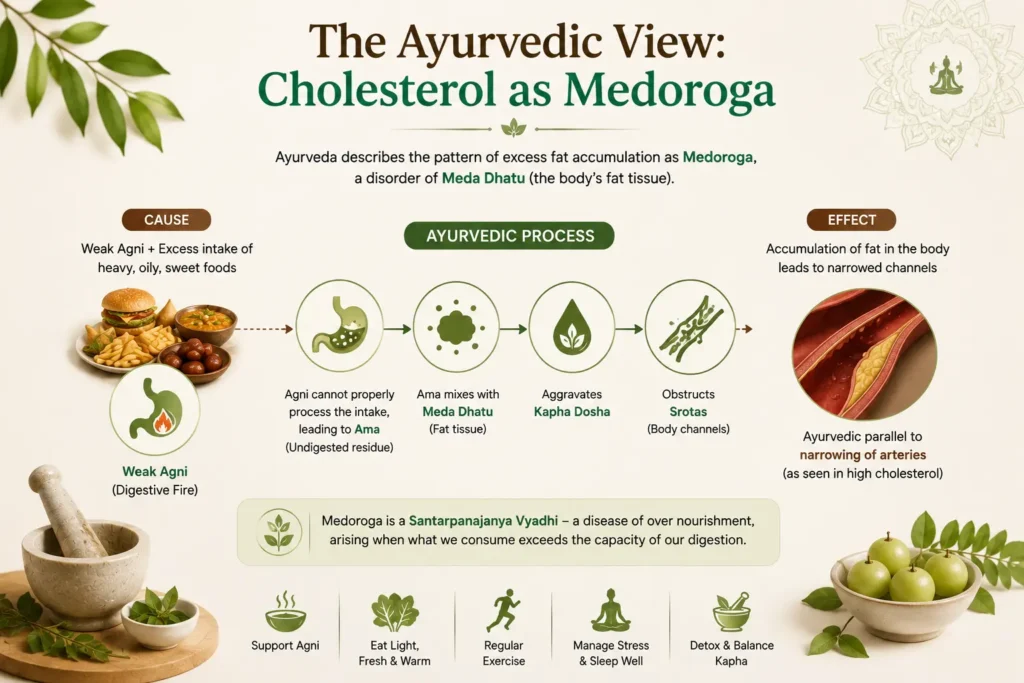
The Ayurvedic View: Cholesterol as Medoroga
Ayurveda does not use the word cholesterol, but it described this pattern of excess fat accumulation long ago as Medoroga, a disorder of Meda Dhatu, the body’s fat tissue. Medoroga is classed as a Santarpanajanya Vyadhi, meaning a disease of over nourishment, arising when digestion cannot keep pace with what is consumed.
The classical explanation centres on weak Agni, or digestive fire, combined with excess heavy, oily and sweet food. When Agni cannot properly process this intake, Ama, or undigested residue, builds up and mixes with fat tissue, aggravating Kapha dosha and obstructing the srotas, the body’s internal channels. This obstruction is the Ayurvedic parallel to the narrowing arteries that concern conventional medicine, arrived at from a different direction but describing a related process.
When High Cholesterol Needs Urgent Attention
Most high cholesterol is a long term risk to manage steadily, not an emergency. But certain signs need immediate medical attention rather than a wellness plan.
- Chest pain, tightness or pressure, especially with exertion
- Sudden shortness of breath, or pain spreading to the arm, jaw or back
- Sudden, severe abdominal pain, which can signal dangerously high triglycerides
- Visible fatty deposits under the skin or around the eyes, particularly at a young age or alongside a strong family history of early heart disease, which may point to a genetic cholesterol condition needing specialist care
If you experience chest pain, pressure or breathlessness, treat it as a medical emergency and seek immediate care. None of the Ayurvedic approach in this guide is meant to delay that. For everything else, this is a condition managed steadily over months, with regular testing to track progress.
Want to Understand What Is Driving Your Numbers?
Get a personalised assessment through Nadi Pariksha, explained clearly with no promises attached.
How Ayurveda Treats the Cause, Not Just the Number
A cholesterol lowering approach that only chases the lab report can bring a number down without addressing why it went up in the first place, which is one reason levels often creep back up once a short term intervention ends. Ayurveda’s approach is built around the underlying pattern instead.
1. Rekindling Agni
Since sluggish digestion is considered central to Medoroga, correcting Agni through diet and routine is usually the starting point, rather than a herb taken in isolation.
2. Clearing Ama and Balancing Kapha
Diet and lifestyle changes aimed at reducing heavy, oily and sweet food help clear the Ama believed to obstruct the body’s channels and aggravate Kapha.
3. Classical Herbal Support
Herbs such as Guggul and Arjuna are traditionally used to support healthy lipid metabolism and heart tissue, chosen based on your specific pattern rather than applied generically. Guggul based formulations should be used under guidance, since they can interact with certain blood thinning medications.
4. Panchakarma for More Involved Cases
For longstanding or more significant elevation, therapies such as Virechana, a supervised purification treatment, are sometimes used to support the body’s fat metabolism, always under close clinical supervision.
This information is for general wellness awareness only and is not intended to diagnose, treat, cure or prevent any disease. Ayurvedic care here is intended as a complementary approach alongside your prescribed treatment, not a replacement for it. Never stop or reduce a statin or any other prescribed medication without your doctor’s guidance.
Diet and Lifestyle for Healthy Cholesterol
- Warm, freshly cooked meals built around vegetables, whole grains and legumes, rather than fried or heavily processed food
- Healthy cooking fats used in moderation, and a reduced intake of deep fried and reheated oils specifically
- Daily movement, including a brisk walk of at least thirty minutes, which supports both Agni and healthy Kapha
- Reduced added sugar and refined carbohydrates, which affect triglycerides more directly than dietary fat for many people
- Consistent sleep and stress management, given how closely both are tied to metabolic health
If weight or blood sugar are also part of your picture, our guides on Ayurvedic care for diabetes and blood pressure management are useful companion reading, since these conditions frequently overlap and respond to many of the same root cause changes.
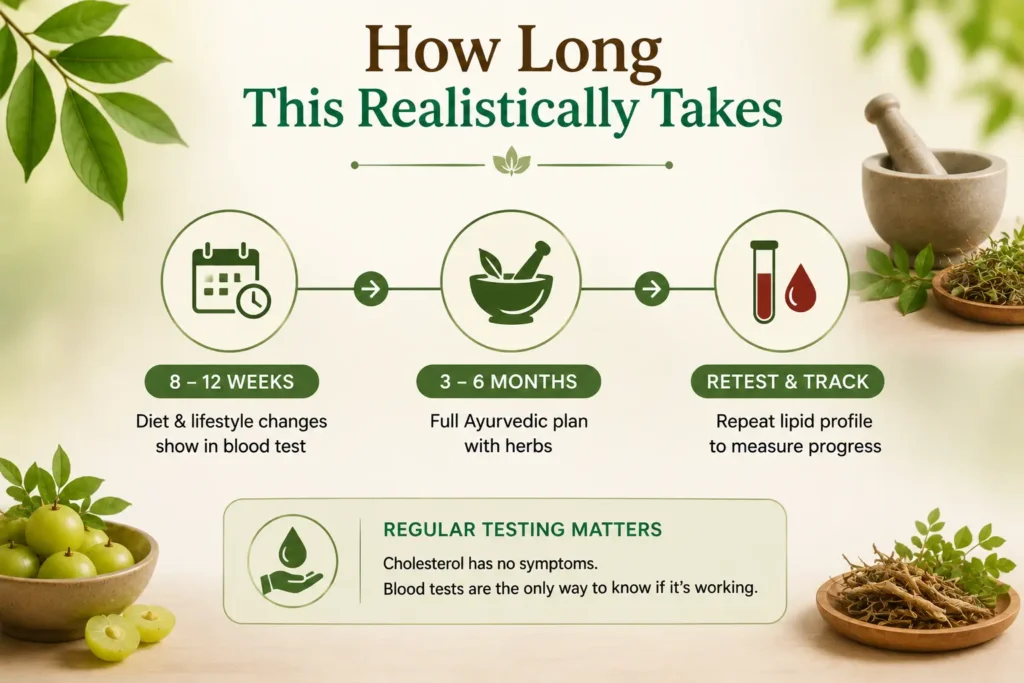
How Long This Realistically Takes
Lipid numbers do not move overnight, in Ayurveda or conventional medicine. Diet and lifestyle changes typically need eight to twelve weeks before a repeat blood test shows a meaningful shift, since that is roughly how long it takes for changed habits to reflect in circulating lipid levels. A fuller Ayurvedic plan, including herbs, is generally followed for three to six months, with a repeat lipid profile used to track actual progress rather than guessing from how you feel.
This is also why regular testing matters throughout treatment, not just at diagnosis. Since cholesterol is symptomless, a blood test is the only honest way to know whether a plan, Ayurvedic or otherwise, is actually working.
Why You Should Question a Guaranteed Cure Claim
Search for natural cholesterol treatment and you will find plenty of promises to reverse it permanently within days, and some content that encourages stopping statins outright. Be sceptical of both, since neither is honest, and the second can be genuinely dangerous.
Statins are among the most well studied medications available, and stopping one without medical guidance can meaningfully raise the risk of a cardiac event. Ayurveda’s role here is complementary, supporting the underlying metabolic pattern alongside your prescribed treatment, not replacing a medication your doctor has assessed you need. Under the Drugs and Magic Remedies (Objectionable Advertisements) Act, advertising a guaranteed cure for a condition like this is not permitted in India, and a clinic willing to overstate this in marketing is telling you something about how it may handle your care too. A physician who checks your actual lipid numbers over time, rather than promising a result in advance, is being more useful to you than one who is not.
What to Ask at Your First Consultation
- What does my specific lipid profile suggest, beyond just the total cholesterol number?
- What is a realistic timeline for my case, and when should I repeat my blood test?
- Are any of these herbs unsuitable alongside my current medication, including statins or blood thinners?
- What diet and lifestyle changes should I prioritise first?
- At what point would you refer me back to a cardiologist or physician for further evaluation?
A trustworthy physician will welcome each of these and answer clearly, including the last one.
Our Approach to Cholesterol Care at Ayurvishwa
- A personalised assessment through Nadi Pariksha and Prakriti Parikshan, rather than a standard protocol applied to every patient
- A realistic timeline given up front, with progress tracked through your actual lipid profile, not assumptions
- Diet and daily routine treated as part of the prescription, not an afterthought
- Care positioned as complementary to your prescribed treatment, never as a reason to stop medication on your own
- Care led by Dr. Vishwas Ghatge, BAMS, MD (Ayurveda), with 18+ years of clinical experience, across 15+ clinics in Maharashtra
📋 In This Article
- Why It Is Silent
- What Raises It
- The Ayurvedic View
- When to Get Urgent Care
- How Ayurveda Helps
- Diet and Lifestyle
- Realistic Timeline
- Guaranteed Cure Claims
- What to Ask
- Our Approach
- FAQs
Get a personalised assessment.
High Cholesterol and Ayurveda, Frequently Asked Questions
Cholesterol builds up gradually inside artery walls over years, a process that does not trigger pain or discomfort until an artery becomes significantly narrowed or a piece of plaque breaks loose. There is no built in early warning system for this, which is why regular blood testing, not how you feel, is the only reliable way to know your levels.
This depends on your individual risk profile, including age, family history and existing conditions such as diabetes, which is why your doctor sets personal targets rather than a single number applying to everyone. Your lipid profile report will typically flag LDL, HDL and triglycerides against general reference ranges, but your doctor’s interpretation for your specific case matters more than the printed range alone.
Ayurveda refers to this pattern as Medoroga, a disorder of Meda Dhatu, the body’s fat tissue, arising from weak Agni, Ama buildup and aggravated Kapha dosha, most often driven by rich diet, sedentary habits and poor digestion over time.
Ayurvedic diet, lifestyle and herbal support is intended to work alongside your prescribed statin or other medication, not replace it. You should never stop or reduce cholesterol medication without your treating doctor’s guidance, since doing so can meaningfully raise your cardiac risk.
General guidance suggests testing every four to six years for adults under forty with no particular risk factors, and every one to two years after forty. Those with diabetes, high blood pressure, obesity or a family history of heart disease are usually tested more often, based on their doctor’s advice.
Chest pain, pressure or tightness, sudden shortness of breath, or pain spreading to the arm, jaw or back need immediate emergency care, since these can signal a heart attack in progress. Sudden severe abdominal pain can indicate dangerously high triglycerides and also needs urgent attention.
For some people, consistent diet and lifestyle changes meaningfully improve lipid numbers. For others, particularly where genetics play a strong role, medication remains necessary alongside lifestyle changes. Your doctor can tell you which situation applies to you based on your specific profile and family history.
Meaningful change in lipid numbers typically takes eight to twelve weeks of consistent diet and lifestyle changes to show up on a repeat blood test. A fuller Ayurvedic plan including herbs is generally followed for three to six months, with progress tracked through your actual lipid profile rather than assumptions.
Both play a role, and genetics can raise cholesterol significantly even in people with a reasonably healthy diet and lifestyle. A strong family history of high cholesterol or early heart disease is worth mentioning to your doctor specifically, since it may change how closely you need to be monitored.
Yes. Mild elevation is often the easiest stage to address through diet, digestion and lifestyle changes, before more significant intervention becomes necessary. Addressing it early, alongside regular monitoring, is generally more effective than waiting for levels to rise further.
Understand What Is Really Driving Your Cholesterol
A personalised assessment through Nadi Pariksha, a realistic timeline, and care that works alongside your existing treatment, not against it.