
Vata Pitta Kapha Nadi Pariksha is one of the most refined diagnostic tools in Ayurveda, where an experienced physician reads the pulse to understand the body’s internal balance. Unlike modern diagnostics that focus on visible symptoms or reports, Nadi Pariksha pulse diagnosis reveals how your doshas are functioning in real time, often before illness fully manifests.
In Ayurveda, the pulse is not merely a heartbeat. Instead, it is a living expression of Vata, Pitta, and Kapha, constantly responding to digestion, stress, lifestyle, emotions, and disease progression. Each dosha creates a distinct movement, rhythm, and quality within the pulse, allowing a trained practitioner to identify imbalances at a root level.
This is why Nadi Pariksha holds such diagnostic depth. By understanding how Vata, Pitta, and Kapha communicate through the pulse, Ayurvedic physicians can detect subtle disturbances, assess disease stages, and design highly personalized treatment approaches. In this article, we explore exactly what your pulse reveals and how Tridosha forms the foundation of Nadi Pariksha.
Tridosha Theory as the Foundation of Nadi Pariksha
Why Pulse Diagnosis Is Based on Vata, Pitta & Kapha
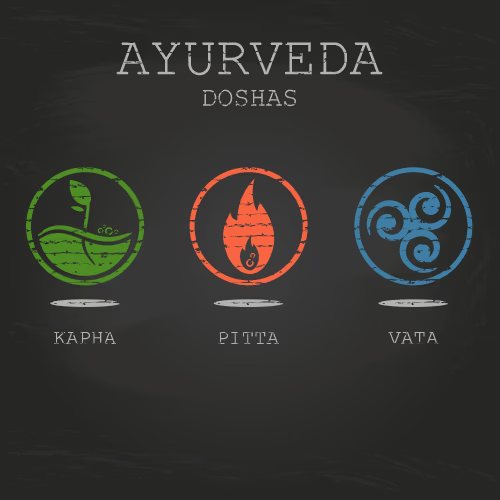
At the core of Ayurveda lies the Tridosha theory, which explains all physiological and psychological processes through three governing energies—Vata, Pitta, and Kapha. Since these doshas regulate movement, transformation, and structure within the body, their balance (or imbalance) directly influences circulation and pulse behavior.
Nadi Pariksha works because the pulse reflects functional changes, not just structural ones. When Vata becomes aggravated, the pulse expresses irregularity and instability. When Pitta dominates, the pulse carries heat and intensity. When Kapha increases, the pulse slows and deepens. Therefore, pulse diagnosis becomes a direct gateway to understanding doshic imbalance long before lab values shift or symptoms worsen.
Unlike questionnaires or body-type assessments, Tridosha-based pulse diagnosis is dynamic. It captures the current state of imbalance (Vikriti) rather than only the individual’s inherent constitution (Prakriti), making it a powerful clinical tool.
How Dosha Dominance Shapes the Pulse
Each dosha leaves a unique signature within the pulse, allowing physicians to differentiate between healthy dominance and pathological imbalance.
- Vata influence introduces variability, lightness, and movement in the pulse
- Pitta influence brings force, warmth, and sharpness
- Kapha influence adds stability, depth, and heaviness
However, most individuals do not present with a single dosha expression. Instead, the pulse often reflects mixed doshic patterns, shaped by diet, lifestyle, stress, age, and chronic conditions. This is why accurate Nadi Pariksha requires years of observation and refinement—misreading doshic dominance can lead to incorrect treatment decisions.
By grounding pulse interpretation in Tridosha theory, Nadi Pariksha transforms from a basic assessment into a precise diagnostic language, capable of guiding long-term Ayurvedic healing.
Understand your dosha imbalance through authentic Nadi Pariksha at Ayurvishwa Healthcare
What Is Nadi Pariksha Pulse Diagnosis?
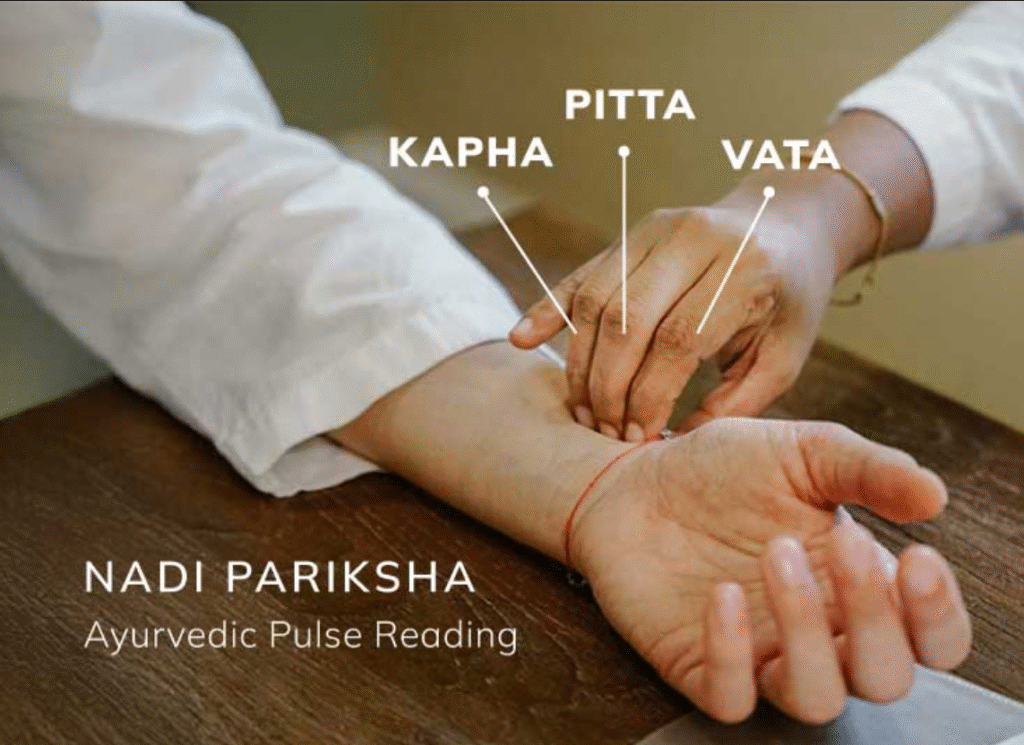
Nadi Pariksha pulse diagnosis is a classical Ayurvedic diagnostic method where the physician reads the pulse to assess the state of Vata, Pitta, and Kapha within the body. Unlike modern pulse checks that measure only heart rate or rhythm, Nadi Pariksha evaluates subtle qualities such as depth, speed, temperature, tension, and movement patterns.
In Ayurveda, the pulse is considered a direct extension of the nervous system and circulatory intelligence. As a result, even minor doshic disturbances are reflected in the pulse before physical symptoms appear. This makes Nadi Pariksha especially valuable for identifying early-stage imbalances and preventing disease progression.
What sets Nadi Pariksha apart is that it does not isolate organs or symptoms. Instead, it interprets the body as an interconnected system where doshas continuously interact and adapt.
How Nadi Pariksha Differs from Checking Pulse Rate
A common misconception is that Nadi Pariksha involves counting beats per minute. In reality, the physician assesses the pulse using three fingers, each corresponding to a dosha position:
- Index finger – Vata
- Middle finger – Pitta
- Ring finger – Kapha
Each finger senses unique qualities at different depths of the pulse. For example, Vata is often felt superficially and irregularly, while Kapha is perceived deeper and steadier. Through this layered assessment, the practitioner determines not only which dosha is dominant, but also how severely it is disturbed.
Why Nadi Is Considered the Language of Doshas
The pulse continuously responds to digestion, mental stress, sleep patterns, emotional state, and metabolic strength. Because doshas govern all these functions, the pulse becomes a real-time expression of Tridosha activity.
This is why Nadi Pariksha is not a one-size-fits-all diagnosis. Two individuals with similar symptoms may have entirely different doshic imbalances—something only pulse reading can reveal accurately. When interpreted correctly, the pulse acts as a diagnostic language that communicates where imbalance exists, how deep it runs, and how urgently it needs correction.
Reading Vata Dosha Through the Pulse
Among the three doshas, Vata is the most sensitive and variable, which makes its pulse characteristics distinct and easily influenced by lifestyle factors such as stress, irregular meals, overexertion, and lack of sleep.
In Vata Pitta Kapha Nadi Pariksha, identifying Vata imbalance is crucial because aggravated Vata often initiates disease processes before other doshas are affected.
Vata Pulse Characteristics in Nadi Pariksha
A Vata-dominant or aggravated pulse typically feels:
- Irregular and uneven
- Light and subtle
- Fast-moving with variable rhythm
- Described in classical texts as snake-like or erratic
The pulse may change quickly under pressure and lacks stability. These qualities reflect Vata’s inherent nature of movement, dryness, and variability.
What a Dominant or Imbalanced Vata Pulse Indicates
When Vata imbalance is detected through Nadi Pariksha, it often points toward disturbances such as:
- Nervous system overload or anxiety
- Digestive irregularities like bloating or constipation
- Sleep disturbances and fatigue
- Degenerative or dryness-related conditions
Importantly, Vata imbalance is frequently the earliest doshic disturbance, even when symptoms are mild or inconsistent. Identifying this through pulse diagnosis allows Ayurvedic physicians to intervene early, preventing more complex Pitta or Kapha involvement later.
Experience traditional Nadi Pariksha guided by clinical Ayurvedic expertise.

Reading Pitta Dosha Through the Pulse
In Vata Pitta Kapha Nadi Pariksha, the Pitta pulse reflects the body’s metabolic intelligence. Since Pitta governs digestion, heat, hormones, and transformation, its presence in the pulse is often strong and unmistakable when imbalanced.
A skilled physician pays close attention to subtle variations in force and temperature, as Pitta imbalance tends to intensify quickly if ignored.
Pitta Pulse Characteristics in Nadi Pariksha
A Pitta-dominant or aggravated pulse is commonly described as:
- Strong and forceful
- Bounding or jumping under the finger
- Warm or hot to the touch
- Rhythmic yet intense
Classical Ayurvedic descriptions often compare the Pitta pulse to the movement of a frog, indicating sudden leaps and powerful momentum. This quality differentiates it clearly from the lighter Vata pulse and the heavier Kapha pulse.
What a Dominant or Imbalanced Pitta Pulse Indicates
When Nadi Pariksha reveals Pitta dominance or aggravation, it often points toward:
- Excess internal heat and inflammation
- Digestive hyperactivity or acidity
- Liver and gallbladder stress
- Hormonal or metabolic overload
Importantly, Pitta imbalance may exist even when routine blood tests appear normal. Through Nadi Pariksha pulse diagnosis, these imbalances can be detected early—allowing correction before they manifest as inflammatory or lifestyle disorders.
Reading Kapha Dosha Through the Pulse
Kapha represents stability, structure, and nourishment within the body. In Nadi Pariksha, Kapha-related pulse patterns are slower and more grounded, reflecting its heavy and cohesive nature.
While Kapha imbalances often develop gradually, they tend to persist if not identified and corrected at the right time.
Kapha Pulse Characteristics in Nadi Pariksha
A Kapha-dominant or aggravated pulse typically feels:
- Slow and steady
- Deep and full
- Smooth, thick, and stable
- Cool in comparison to Pitta
Classical texts describe the Kapha pulse as resembling the glide of a swan, indicating smoothness and continuity rather than speed or force.
What a Dominant or Imbalanced Kapha Pulse Indicates
When Kapha imbalance is detected through Nadi Pariksha, it commonly suggests:
- Accumulation and congestion within the body
- Sluggish digestion and metabolism
- Fluid retention or weight-related concerns
- Long-standing or chronic tendencies
Unlike Vata and Pitta, Kapha imbalance often masks itself behind stability. This is why Nadi Pariksha pulse diagnosis becomes essential—it reveals stagnation and accumulation before visible symptoms fully develop.
Mixed Dosha Pulses: When Vata, Pitta & Kapha Interact
In real clinical practice, most individuals do not present with a single dosha imbalance. Instead, Vata, Pitta, and Kapha often interact simultaneously, creating complex pulse patterns that require deep experience to interpret accurately. This is where Vata Pitta Kapha Nadi Pariksha moves beyond theory and becomes a true diagnostic art.
Mixed dosha pulses reflect the layered nature of imbalance—where one dosha may dominate on the surface, while another operates at a deeper level. For example, a patient may show an externally strong Pitta pulse, yet a subtle underlying Vata disturbance may be driving disease progression.
How Dual-Dosha and Tri-Dosha Pulses Are Identified
During Nadi Pariksha pulse diagnosis, physicians assess:
- Variations across different pulse depths
- Shifts in rhythm and pressure between doshic positions
- Contrasting temperature or movement patterns
A dual-dosha pulse (such as Vata-Pitta or Pitta-Kapha) presents mixed qualities—irregularity combined with force, or stability with heat. In tri-dosha imbalance, the pulse may feel inconsistent, complex, and difficult to categorize without trained sensitivity.
These nuanced patterns cannot be decoded through self-assessment or digital tools. Accurate interpretation depends on years of clinical exposure and continuous refinement.
Why Mixed Dosha Pulses Are Often Misread
One of the biggest challenges in Nadi Pariksha is misinterpreting surface-level dominance. Treating only the most obvious dosha can temporarily suppress symptoms while leaving the root cause untouched.
For instance, addressing Kapha accumulation without correcting underlying Vata disturbance may lead to recurring issues. This is why classical Ayurvedic training emphasizes listening to the pulse holistically, rather than isolating a single dosha in isolation.
What an Experienced Nadi Pariksha Practitioner Can Detect
An experienced practitioner does far more than identify which dosha is aggravated. Through Nadi Pariksha pulse diagnosis, subtle yet critical insights emerge, often before symptoms become clinically obvious.
These include:
- Severity of dosha imbalance – mild, moderate, or advanced
- Stage of disease development – early imbalance vs chronic manifestation
- Digestive strength (Agni) and its impact on doshas
- Toxin accumulation (Ama) influences pulse quality
- Organ-specific doshic disturbance reflected in pulse depth and rhythm
Because the pulse responds instantly to internal changes, it acts as a diagnostic bridge between current imbalance and future disease risk. This makes Nadi Pariksha especially valuable in preventive and chronic care settings.
When interpreted correctly, pulse diagnosis allows treatment to be precise, minimal, and aligned with the body’s natural healing intelligence, rather than relying on trial-and-error approaches.

Begin your healing journey with accurate Tridosha diagnosis at Ayurvishwa Healthcare.
Nadi Pariksha Interpretation at Ayurvishwa Healthcare
At Ayurvishwa Healthcare, Nadi Pariksha is practiced as a core diagnostic science, not a superficial assessment. The interpretation of Vata, Pitta, and Kapha through pulse diagnosis is done with clinical precision, rooted in classical Ayurvedic principles and refined through real-world patient outcomes.
Rather than treating pulse diagnosis as a one-time reading, Nadi Pariksha at Ayurvishwa Healthcare is integrated into the entire treatment journey. The pulse is assessed to understand:
- The dominant and disturbed doshas
- The depth and chronicity of imbalance
- How digestion, metabolism, and stress are influencing disease progression
This Tridosha-based pulse interpretation helps guide personalized treatment protocols, ensuring that therapies are aligned not just with symptoms, but with the body’s internal imbalance pattern. As a result, treatment plans are more targeted, effective, and sustainable over time.
Ayurvishwa Healthcare emphasizes root-cause correction, using Nadi Pariksha as a compass to monitor how Vata, Pitta, and Kapha respond to treatment—allowing timely adjustments when needed.

About Dr Vishwas Ghatge
Dr Vishwas Ghatge is an experienced Ayurvedic physician doctor in Pune with a strong clinical focus on Nadi Pariksha pulse diagnosis and Tridosha-based assessment. His diagnostic approach is grounded in the belief that an accurate understanding of Vata, Pitta, and Kapha imbalances is the foundation of effective healing.
With extensive hands-on experience in reading complex pulse patterns, Dr Ghatge specializes in identifying:
- Early-stage doshic disturbances
- Mixed and layered Tridosha imbalances
- Chronic conditions where symptoms and reports fail to explain the root cause
What distinguishes his approach is the emphasis on precision over assumptions. Instead of treating conditions based solely on visible symptoms, Dr Ghatge relies on pulse diagnosis to understand how internal systems are functioning in real time. This allows for treatment strategies that are individualized, adaptive, and aligned with Ayurvedic fundamentals.
Patients seeking Nadi Pariksha under Dr Ghatge benefit from a diagnostic process that prioritizes clarity, accuracy, and long-term balance, making Ayurveda both practical and deeply personalized.
Final Thoughts
When interpreted correctly, the pulse reveals far more than a heartbeat—it reflects the dynamic balance of Vata, Pitta, and Kapha within the body. Through Nadi Pariksha pulse diagnosis, subtle imbalances can be identified early, guiding precise and individualized Ayurvedic care.
At Ayurvishwa Healthcare, Nadi Pariksha is practiced with clinical depth and diagnostic integrity, ensuring that treatment begins with a clear understanding of the body’s internal state. By focusing on Tridosha balance rather than surface-level symptoms, Ayurvedic healing becomes more effective, sustainable, and aligned with long-term health.
Frequently Asked Questions
Nadi Pariksha identifies dosha imbalance by assessing the pulse’s rhythm, depth, force, and movement. Each dosha—Vata, Pitta, and Kapha—creates a distinct pulse pattern that an experienced Ayurvedic physician can interpret accurately.
A Vata-dominant pulse typically feels irregular, light, and fast-moving. It may fluctuate under pressure and is often described as snake-like in classical Ayurvedic texts.
Pitta imbalance is detected when the pulse feels strong, forceful, and warm. The pulse often jumps or bounds under the finger, reflecting excess heat and metabolic activity.
A Kapha-imbalanced pulse feels slow, deep, steady, and heavy. It may indicate accumulation, sluggish digestion, or long-standing metabolic imbalance.
Yes, Nadi Pariksha can identify dual-dosha and tri-dosha imbalances by evaluating variations across different pulse depths and positions. Mixed dosha pulses require experienced interpretation.
Yes, Nadi Pariksha can detect doshic imbalance even before symptoms appear. This makes it valuable for early intervention and preventive Ayurvedic care.
Stress often aggravates Vata first, creating irregular pulse patterns. Over time, it can also disturb Pitta or Kapha, depending on the individual’s constitution and lifestyle.
Tridosha assessment frequency depends on health goals. For chronic conditions, periodic pulse evaluation helps monitor doshic response to treatment and lifestyle changes.
Yes, Nadi Pariksha directly informs treatment planning by identifying the root dosha imbalance, disease stage, and internal strength, allowing personalized Ayurvedic interventions.
Vata Pitta Kapha Nadi Pariksha should be performed by a trained and experienced Ayurvedic physician, as accurate pulse interpretation requires years of clinical practice.